Abstract:
The article explains why a long, ordinary desk day can make your mid-back feel like it “goes offline” without any dramatic injury—more like wearing a torso cast that only “reboots” a few steps after you stand—arguing this is often a load‑sharing problem rather than damage: when the ribcage and thoracic spine stop contributing to everyday rotation, reaching, and breathing (common when you’re pinned to a chair, eyes locked on a screen, trying to look present by staying still), movement gets rerouted so the neck turns more, the shoulders reach more, and the low back twists more than it’s built for. Using a calm, non-alarmist model (including rough rotation “budget” numbers that highlight how limited lumbar rotation is compared with thoracic rotation), it offers non-medical “debug signals” like noticing neck-only turning to a second monitor, shoulder-hike reaching for a charger that’s always 20 cm too far, or relief from a big crack that evaporates 30 seconds later. The practical solution is deliberately boring: add tiny, meeting-safe micro-actions—small chair-and-torso turns, subtle side-bends with an exhale, or “ribs-first” reach-backs—anchored to existing “seams” such as hitting Send or ending a call, with a degraded mode for brutal days (one exhale and a 5° turn), track just one simple 18:00 rating if you want data, and use clear guardrails and red flags for when symptoms warrant real evaluation; the goal isn’t perfect posture or a new identity, but restoring a bit of ribcage contribution so the neck and low back stop doing unpaid overtime and the end-of-day crack cravings fade.
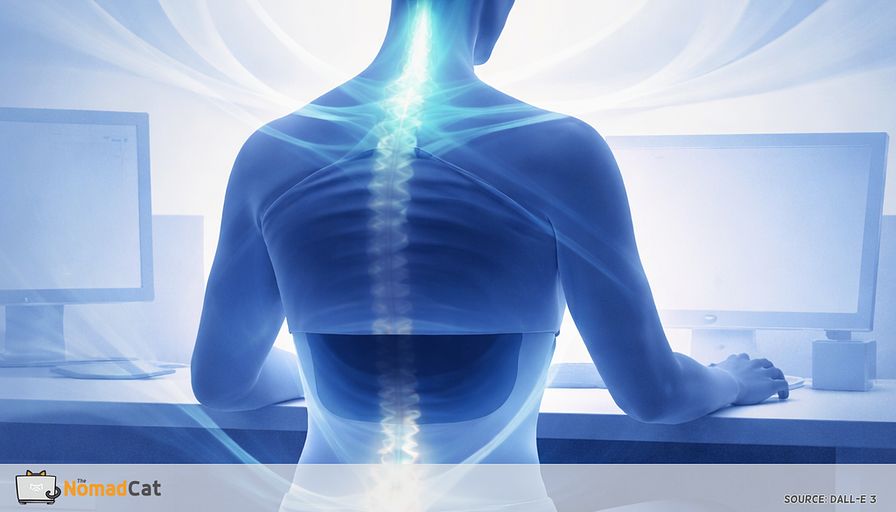
A normal desk day can do a weird thing to the middle of your back. Not a dramatic “I lifted wrong” moment. More like the mid-back just… goes offline. You’re in meetings, eyes locked on a screen, trying to look engaged while staying oddly still. Then you stand up and it takes 3 steps before your torso feels like it’s part of the plan again.
If that sounds familiar, this is a calmer explanation than the usual posture scolding. The goal isn’t to diagnose you or sell you a perfect setup. My wife is a fitness trainer and nutritionist and she still tells me to sit straight; I usually manage about 3 minutes. It’s to show a practical model for why the neck, shoulders, and low back start doing extra work when the ribcage stops helping with turning, reaching, and breathing.
Here’s what you’ll get, without turning your calendar into a movement management app
- why desk stillness can feel like a torso cast even when nothing is “damaged”
- the ribcage and mid-back as the missing middle layer that helps share rotation and reach
- a few non-medical “debug signals” that show where movement is getting rerouted
- small, meeting-safe micro-actions that fit into real work, using simple seams like hitting Send or ending a call
- sensible guardrails and red flags so this stays in the “small experiment” category, not panic fuel
The win condition is boring on purpose. A bit more ribcage contribution. Less neck-only turning. Less shoulder-only reaching. Fewer end-of-day crack cravings. Not perfect posture, not a new identity, just better load sharing in a system that’s been stuck in one position for 8–10 hours.
The mid back that goes offline at a desk
Why a normal desk day can feel like a torso cast
You sit down with good reasons. Keyboard close. Eyes locked on near-focus. Camera on, polite face, minimal fidgeting. A meeting that should be 25 minutes becomes 55. Slack pings, doc tabs, and that tiny pressure to look “present” by staying still. I’ve done this across Beijing offices, then Berlin remote years on bad chairs, and now in Lisbon, still at the desk past midnight.
If you’ve done enough desk days, you start noticing a pattern. Not even a dramatic “bad posture” moment, honestly. More like long stretches of stillness with very little recovery or variation.
It often shows up like this
- upper back feels like a flat plate that doesn’t “join” the movement
- breath feels stuck high, like the ribs forgot they can move
- turning to look left or right becomes neck-only
- reaching becomes shoulder-only, like the torso opted out
- end of day urge to crack, twist, roll shoulders, anything
- standing up takes 3 steps before the middle of the back feels awake
None of that automatically means damage. It can be a distribution problem. A system can run “fine” for hours while quietly overloading 1 component. Also, imaging findings are common even in people who feel fine, so sensations aren’t proof of structural doom.
A useful model is the ribcage and thoracic spine as the missing middle layer in the movement stack. Think load sharing. When that middle layer contributes less, motion gets rerouted. The neck does extra turning, shoulders do extra reaching, and the low back handles more twist than it really wants. Nothing is “broken.” It’s just a workaround.
Why ribs need small movement all day
Turning and reaching is a shared job
Comfortable turning is usually shared between the thoracic spine and ribcage plus the hips. The low back is not built to be a big rotator.
Some rough reference numbers help with the “budget” idea. Thoracic rotation is often around 30–50° per side, while lumbar rotation is much smaller, roughly 5–15° per side. Bodies vary and these aren’t targets. The point is simpler: if the thoracic share disappears, the neck and low back don’t have infinite spare degrees to cover it.
Now add desk constraints. Pelvis pinned to a chair. Forearms living on the desk. Eyes locked on near-focus. Breathing often gets smaller without anyone deciding to do it. Slumped sitting can reduce thoracic extension range, and it can change shoulder blade mechanics during arm movement. Not an ergonomics lecture, just cause and effect. A low-tech check: notice if your first reach of the day is smooth, but by the 5th meeting you start shrugging to reach the same mug.
Moving less isn’t a character flaw. It’s a predictable outcome of an environment that rewards stillness and penalizes fidgeting. Over time, what seems to matter is having options and variability, not holding a perfect spine angle like a screenshot. And fear-heavy posture talk can make things worse, so keeping the story calm helps.
When the ribs stop helping the neck and low back step in
Movement still needs to happen
Desk life still asks for rotation and reach.
- turning to the 2nd monitor
- swiveling to hear someone on a call
- looking over your shoulder while staying planted
- reaching for water, headphones, or the charger that’s always 20 cm too far
If the ribs and pelvis don’t join in, smaller joints fill the gap. The neck is usually the first easy borrower. That doesn’t mean your neck is fragile. It’s often high-volume small work, plus constant low-level stabilizing because attention and near-vision make people hold still.
Like a CPU that looks fine but has background processes eating cycles, the neck can be doing quiet corrections for hours until it complains.
The low back can borrow rotation too, especially when sitting pins the pelvis. You won’t be able to prove this at your desk, but the pattern is consistent: pelvis pinned + ribs quiet = low back tries to rotate.
Then the shoulders start doing torso work. A ribcage that doesn’t move well changes the platform the shoulder blades sit on. Reaching becomes more crank-forward-and-up than shared range through the upper back. Slumped posture can alter scapular mechanics, and increased kyphosis is associated with symptoms. Association, not a verdict.
Your log files when the ribcage is the bottleneck
4 debugging signals that stay non-medical
Think of this as reading log files, not running a medical scan. These are not diagnostic. The point is noticing where movement is happening so tiny changes have somewhere to land.
1) Does your sternum come along when you turn your head?
Not a formal test. Just notice if turning is neck-only or if the chest follows a little.
2) Are you turning neck-first at work?
Second monitor. Someone calling your name. Notification behind you. If it’s consistently neck-only, it may mean the ribcage is under-contributing that day, especially with stress or a chair that doesn’t swivel.
3) How do you reach for normal stuff?
Watch the repeats.
- always lead with the same shoulder
- jacket-on twist where 1 arm does a weird backflip
- bag behind the chair grabbed with a shoulder hike
- charger cable “only” 20 cm away but somehow a shoulder-only event
Often it’s a coordination workaround when rib rotation and side-bend aren’t really available.
4) Do your “30 second fixes” evaporate?
Big twist, crack, shoulder roll. Feels great for 30 seconds. Then 2 meetings later you’re back in the same default shape. That’s not because stretching “doesn’t work.” It’s usually an input mismatch. One strong input can’t compete with 8–10 hours of the same movement diet. Variability and recovery tend to win.
A 20 second rib share that survives real work
Pick 1 seam so it actually happens
Timers are like cron jobs in a chaotic system. They run, but the scheduler is busy and the job gets skipped. Seams work better because they hook into events that already happen.
Pick 3 seams you already hit every day—after you hit Send, when a meeting ends, and when you unmute—and attach 20 seconds to those moments so it survives a real calendar.
A seam is only useful if it doesn’t look like a mini workout. The meeting-safe version is subtle enough that nobody notices. Perfect habits don’t survive real calendars anyway.
Expectations stay small. This isn’t “fixing posture.” It’s just giving the ribcage a tiny share of the movement budget so the neck and low back stop overbilling every time you turn or reach.
3 micro-actions that reintroduce rib motion quietly
Pick the least annoying option.
Option 1 tiny chair-turn
- plant feet and make them feel heavy
- rotate chair and torso together about 10–20°
- pause for 1 slow exhale, then other side
Option 2 tiny side-bend plus exhale
- slide 1 hand tiny down the thigh
- tiny side-bend and exhale once
- come back, switch sides
Option 3 reach-back ribs-first
Not a stretch. More like a reminder that ribs can rotate with the arm so the shoulder doesn’t have to manufacture all the range.
- keep elbows soft and neck quieter than usual
- reach 1 arm slightly back while letting ribs rotate with it
- take 1 breath, then switch
Degraded mode for brutal days. If 20 seconds feels impossible, do 1 exhale plus a 5° torso turn and stop. Frequency beats hero moments when the load is low-level and sustained.
Boring signals that it is working
Success looks boring on purpose
If the ribcage starts paying its share again, the wins are small.
- head turns feel smoother often without the neck leading
- shoulders sit a bit lower often without you “setting posture”
- standing up and walking feels less compressed for the first 10 steps
- fewer dramatic cracks because the system isn’t starving for variation
One number at 18:00 is enough
If you like data, keep it almost insulting in how simple it is. Pick 1 rating, once a day at 18:00, 0–10. I do it because otherwise I will convince myself everything is “fine” until my upper back votes no.
Examples
- neck heaviness
- ease of turning
- upper-back stuckness
Population data for thoracic-specific issues is messy anyway. Your baseline matters more than chasing average numbers.
Guardrails that keep this sensible
This is exposure tuning not diagnosis
This is about options and exposure, not figuring out what is “wrong.” If symptoms are mild, desk-shaped, and predictable, small experiments are generally reasonable. If symptoms escalate fast, feel strange, or don’t match the pattern, don’t bargain with them.
Red flags that deserve real evaluation
Get checked sooner rather than later if there is
- progressive numbness or weakness, new clumsiness
- major trauma or a new accident
- sudden severe headache or neurological symptoms (for example: unusual dizziness with double vision, slurred speech, facial droop, or severe unsteadiness)
If you’re also dealing with unexplained fever, weight loss, or feeling systemically unwell, that belongs in the “talk to a clinician” bucket too.
The win condition is load sharing
The target isn’t perfect posture or turning your calendar into a movement management app. It’s getting back a bit more variability and ribcage contribution, so the neck and low back do less extra work. Small, well-placed inputs can be a quiet configuration fix.
If you stand up and your first breath still feels stuck high, that’s a useful signal: the ribs didn’t get invited back into the day yet. Try the smallest version of the micro-actions at the seams you already have, and see if your turning and reaching starts to feel less like it’s coming from the wrong places.
You might be interested by these articles:


Direction matters fix the one sided desk day

The hidden desk twist that makes your neck do overtime

Your posture is not broken your attention is running the brace

Your watch logged the workout but your shoulders still filed a bug report at 18:00

When desk focus puts your breathing on mute

Unveiling the Power of Info in Tech Evolution

Minimalist clothing for tech comfort and focus