Abstract:
The article explains a common “remote desk-day signature” where back-to-back camera-on meetings and keyboard-compatible lunches quietly strip out normal mouth and neck movement—less chewing, fewer full swallows, more still “polite” face time—and by evening (often around 20:00) this missing mechanical input shows up as an oddly tight-collar feeling, a dry or sticky throat, and a tired jaw despite having “only sat” all day. Rather than blaming discipline or offering a diagnosis, it frames the problem as environmental selection pressure (soft, silent, pause-safe foods; hydration postponed until late; breaks that feel socially expensive due to meeting overrun, resumption lag, and telepressure) plus distracted eating that’s poorly remembered and can plausibly drive 16:00 snacking, supported by research on attention and later intake. It then treats chewing and swallowing as real, measurable movement (while noting evidence is stronger for texture changing workload than for low chewing causing pain) and suggests the neck can get recruited as a stabilizer when the jaw is subtly “on” all day. The practical fix is deliberately unheroic: use existing “seams” (after hitting Send, when Zoom ends, when an upload finishes) for a 10–20 second camera-safe reset—teeth slightly apart with soft lips, tongue wide and relaxed, one easy swallow, one slow quiet exhale—and keep lunch the same but add one low-mess chew-required component (like apple/pear slices, carrots/cucumber, bread, or nuts on mute), while monitoring simple success signs and observing clear stop-and-seek-care red flags for swallowing, voice, neurologic, or ENT symptoms.
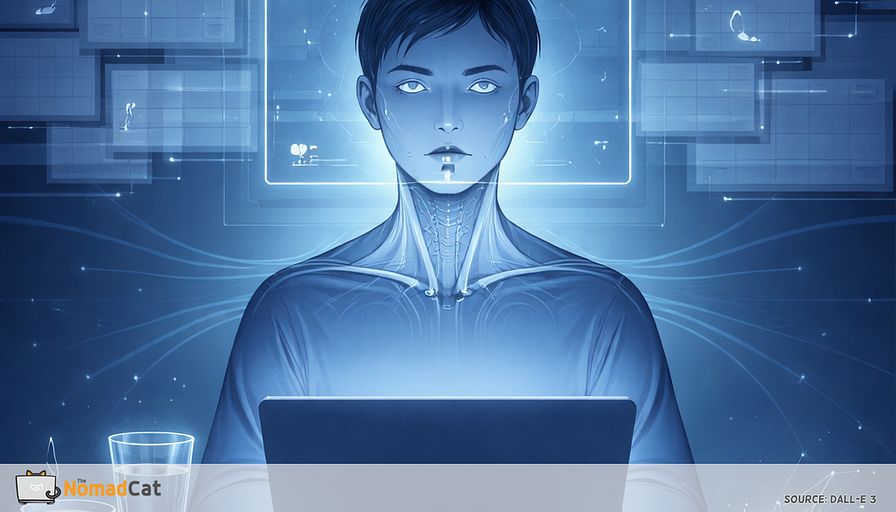
Calendar blocks touch. Camera on. Mic muted. Lunch becomes a file you try to upload in the background while staying “present” on screen.
And then the weird part happens at 20:00. Nothing dramatic happened today, just sitting. Yet the jaw feels a bit tired. The throat feels dry or sticky. The collar feels tighter. It can feel ridiculous, like your body is throwing errors for a task you did not even notice running.
This article is for that exact desk-day signature. Not as a diagnosis, and not as a discipline lecture. More like a systems check. Remote work quietly removes a lot of small mouth and neck movement, and meeting culture rewards food that is soft, silent, and instantly pausable. Less chewing. Fewer full swallows. More “hold still and look normal” face time. The inputs change, so the output changes.
I have done the desk years in Beijing, then Berlin, and now Lisbon, with the last stretch mostly remote. My wife is a fitness trainer and nutritionist; she reminds me regularly to sit straight. I usually manage about 3 minutes, then the calendar wins again.
What you will get here is simple and practical, built for a 10-hour day where breaks are socially expensive and meetings leak.
We will cover
- Why desk lunches slide toward soft and silent even when you planned a real meal
- What distracted eating does to meal memory and why 16:00 snacking can make sense without any moral story
- The mechanics part, chewing and swallowing as real movement that disappears when everything is keyboard-compatible
- Why the neck often gets drafted into stabilizing when the jaw is doing low-level holding all day
- A small “seam” approach using 10 to 20 seconds between tasks, not timers, plus a camera-safe 4-step sequence
- One lunch tweak that keeps your lunch the same, but adds 1 chew-required piece
- Basic guardrails and red flags so this stays in the “desk experiment” lane, not DIY medicine
If the problem is missing input, the fix does not need to be heroic. It can be 1 tiny movement event, repeated where the day already has seams. Enough to stop the error log from filling up by evening.
The desk day that deletes mouth movement
A mouth that looks busy but stays mechanically idle
Calendar blocks touch each other. Camera is on. Mic is on mute.
The face stays polite and still, like a UI that must not flicker.
You talk when needed. You nod a bit. You keep a neutral half-smile.
But the mouth does not get the normal variety of movement. No real chewing. Fewer full swallows. Almost no small “maintenance” motions. The jaw becomes a stabilizer, not a mover.
This is not a personal failure. It is missing input, by design.
Lunch is where it shows up fastest.
Even when someone schedules lunch, meeting culture makes it fragile. A call starts at 12:55. Another one “just 15 min”. Then a message that needs a fast reply. The system selects foods that are pause-safe and camera-safe, so often low-chew by default.
No time buffer means no plate. No plate means no fork. No fork means something soft, or liquid, or eaten while typing. Chewable food is higher friction in this context. A napkin appears on screen. Chewing sounds happen. Someone asks a question mid-bite, and you answer like nothing is happening.
Hydration drifts the same way.
The water glass stays strangely full until 16:00. Then it disappears in 3 big gulps.
Also, people tend to swallow less when attention is locked on a screen. Real meeting data is limited, but the pattern is familiar.
A skeptical take helps. Desk work is basically long exposure to sitting and small, repetitive effort. Microbreaks help, and they are also hard to keep when work is dense.
Movement variety matters too. The body handles load better when patterns vary, not when posture is “perfect.”
Same idea for the mouth and neck: low-level holding can feel like nothing while it’s happening, then show up later once enough hours pass without real off periods. This is not a diagnosis. It is a desk-day signature.
Why desk lunches slide toward soft and silent
The design forces you did not choose
This is not you “being weak with food”. It is selection pressure. Your calendar, your laptop, and your camera settings reward pause-safe eating.
Here is the moment: you are on mute, camera on, chewing something that requires effort. The doc is scrolling, your trackpad hand is busy, and you try to keep the jaw invisible. Then you get the question mid-bite, you swallow early, and you answer with the polite face like nothing is happening.
Foods and formats that win in a meeting-heavy day tend to be
- One-handed and keyboard-compatible
- Quiet with no crunch, no slurp, no obvious chewing
- Clean with low drip risk
- Instantly pausable so you can answer a question without doing the guilty hamster face
- Low attention so you can keep reading the doc while the mouth does the minimum
Foods and formats that lose are often the normal ones
- Crunchy things that make your mic sound like a fireplace
- Anything that needs a fork, 2 hands, or a plate that must be defended from your trackpad
- Messy textures that create a new problem every 30 seconds
- Real chewing that makes you choose between being present and being fed
When lunch is distracted, the brain logs it badly
When lunch happens inside the work stream, people often remember it less clearly, and that weaker “meal memory” is linked with more later snacking (Robinson et al., 2013). Desk version: you ate while answering messages, a call started at 12:55, and by 16:00 your brain behaves like lunch never really happened.
Practical implication, no moral attached.
Why tiny breaks feel socially expensive
Breaks get deleted first because two forces stack together.
First, meetings do not end, they leak.
Second, even a 3-minute pause has a restart cost.
And then there is the simple behavior: replying instantly becomes a status signal.
Short breaks can reduce discomfort and fatigue (Henning et al., 1997; Galinsky et al., 2000). Real-world follow-through is the problem. Dense work systems make breaks hard to keep.
So yes, mouth maintenance movements disappear first. Not because you lack discipline. Because the environment prices them like a luxury.
Chewing and swallowing as mechanical input
Chewing is measurable movement
Change food texture, and chewing changes in measurable ways. Reviews on chewing show shifts in chewing cycles, total chewing time, jaw movement patterns, and jaw muscle activity as texture gets harder or softer (van der Bilt, 2011). Lab work shows similar changes in muscle activity and movement tracking (Foster et al., 2006).
Liquids mostly skip chewing. Soft foods reduce workload. Solids increase it. This is not diet advice. It is mechanics.
Important boring caveat. Less chewing is not proven to cause jaw pain in a clean, predictable way in healthy adults. Texture changes workload. The jump from “less chewing” to “you will develop a problem” is where the evidence gets thinner.
Swallowing is a coordinated event
A swallow is a coordinated “move food down safely” event: the tongue and throat have to work in sequence, and the airway has to stay protected. When you do fewer full swallows because you are focused and still, the mouth can get dry and the throat can feel sticky.
With solids, chewing builds the bolus and can involve staged transport, not a simple “finish chewing then swallow” sequence (Palmer et al., 1992). It is like batching files versus sending single packets.
When full swallows drop and attention stays glued to a screen, small substitute behaviors can show up. Throat clearing. Lip pressing. Tongue rubbing. They give 2 seconds of relief, which is exactly how a loop gets reinforced.
Why the neck gets drafted into the job
Stabilization spreads upward
The jaw does not live alone in a neat little box. If the mouth area is subtly “on” all day, teeth hovering near contact, tongue pushing a bit too firmly, lips sealed because you are on camera, the neck can get pulled in as a stabilizer. Jaw and neck coupling makes this plausible, even if real meeting data is limited.
End-of-day sensations that often show up in this zone can look like
- Tight front-of-neck or a tight collar feeling
- SCM tenderness when you press the side of the neck
- Upper traps that feel permanently slightly shrugged
- Temple pressure that feels like screen fatigue but not only eyes
- A throat that wants clearing even when nothing is there
- A jaw that feels tired without any big chewing day
These are logs, not a diagnosis. If symptoms are persistent, worsening, or severe, or if there are swallowing or voice red flags, a real clinical assessment matters.
A 10 to 20 second seam that brings back mouth input
Use seams, not timers
Timers are socially loud. They fire mid-sentence.
Seams, they are more discreet.
Useful triggers are things like you hit Send, a Zoom meeting ends, you mute, a deploy finishes, an export completes, an upload bar reaches 100%, the calendar tab closes.
Microbreak research tends to favor frequent, short breaks over heroic breaks you never take. Trials often show reduced discomfort and fatigue without long interruptions.
The 4-step sequence that stays camera-safe
This is not a posture lecture. It is 1 clean movement event.
- Teeth apart 1 to 2 mm and lips soft
- Let the tongue go wide and soft in the mouth
- Do 1 easy swallow
- Do 1 slow, quiet exhale
Mechanically, it interrupts jaw holding and tongue bracing. The exhale works as a downshift cue. It is easy to oversell breathing metrics though. HRV is noisy and device-dependent, so this is not “increase HRV in 10 seconds” content.
Optional add-on for chew input, no gum required. At lunch, take 1 bite of something already there and chew it 3 times, then stop. Texture changes chewing workload in measurable ways (van der Bilt, 2011; Foster et al., 2006). If chewing or gum worsens jaw pain, stop. More is not automatically better.
A desk lunch tweak that is about mechanics
Keep lunch the same, add 1 chew-required part
Make it desk-real and low-mess so it survives a bad calendar.
Rule of thumb, 1 component of lunch must require chewing, everything else can stay exactly as it is.
Examples that work with mute buttons and trackpads
- Crunchy fruit like a small apple, pear slices
- Crunchy veg like carrots, cucumber sticks
- Dense bite like a piece of bread, half a sandwich
- Nuts if your mic is muted and you can keep it tidy
The win is 2 to 3 minutes somewhere, not a perfect meal.
How to tell it is working and when to stop
Boring success checks
Keep it minimal so it does not become another tab.
Useful outcomes that are easy to notice
- Less urge to throat-clear in the late afternoon
- Fewer tight collar moments after back-to-back meetings
- Less jaw tiredness right when work stops
- Neck and traps drop faster after a call instead of staying in shrug mode
Day-to-day noise is normal. Meetings, sleep, and stress load still swing the numbers.
Set expectations correctly. Evidence is strong that texture changes chewing workload. Evidence is weaker that reduced chewing alone causes pain in healthy adults. Treat this as exposure testing, not treatment.
Guardrails and red flags
Stop DIY and get assessed if any swallowing or airway safety signs show up
- Swallowing feels progressively harder over days or weeks
- Coughing or choking with food or liquids
- Wet or gurgly voice after swallowing
- Recurrent chest infections or pneumonia
- New neurologic signs such as face droop, arm weakness, speech trouble, sudden severe dizziness, or acute confusion
ENT red flags also deserve a real look
- Voice change or hoarseness lasting more than 2 to 4 weeks
- A new neck lump or mass that persists or grows
- Bleeding, coughing blood, unexplained weight loss, or escalating one-sided throat pain
- Severe reflux symptoms with progressive pain or swallowing trouble
Not alarmism. Throat symptoms are nonspecific, so thresholds exist to avoid missing the important stuff.
Last caution. If chewing makes jaw pain worse or there is known painful TMD, keep chew inputs small and stop if symptoms spike. The goal is gentle variability and a little missing movement back in the day, then see what the end-of-day logs say.
If your day is wall-to-wall calls, it makes sense that your mouth ends up doing less real work. Desk lunches drift toward soft, silent, pause-safe food. Swallowing and chewing get reduced. The face stays “camera-normal,” and the jaw and neck quietly pick up the slack.
The useful idea here is small input, not heroics: 10 to 20 seconds after Send, after mute, after a meeting ends, plus one chew-required piece at lunch. Even in dense days, seams still exist—and sometimes that is enough for the evening to feel less tight, less dry, less “why is my jaw tired from sitting.”
You might be interested by these articles:


The mic-mute swallow gap behind your 16:30 throat crash

Why video calls wreck your neck after you hit Leave

Chew Gate for Meeting Days When Your Tools Keep Picking Coffee for Lunch

When eating looks unprofessional and your afternoon runs on coffee

Camera on jaw clenched the desk day micro hold

Count exits not steps a 60-second outside fix for remote days

The shutdown headache when work stops and your head logs catch up