Abstract:
The article explains why a remote workday can look “light” on the calendar yet still leave you wired and drained by 18:00: the problem often isn’t discipline or workload, but fragmentation plus the loss of ultra-brief, low-stakes in-person contact—“micro-social repair”—the 5–45 second nods, hallway jokes, quick “got it” smiles, or even mildly awkward but non-evaluative exchanges that used to downshift the nervous system and mark small transitions between roles. Remote work strips out these accidental resets and replaces them with more explicit, persistent, and judgeable signals (green dots, timestamps, “seen” receipts, camera tiles, recorded calls), which increases self-monitoring and interpretation pressure—especially on video where you can feel “on stage,” and in text where people end up rereading a Slack line six times to avoid sounding cold. Instead of prescribing routines or “connect more,” the piece offers small, voluntary replacements that fit into real desk days: quick status scripts that reduce tone-guessing and telepressure (“Heads down til 14:45,” “Saw this, noted,” “No need to respond tonight”), occasional channel swaps like a sparing voice note when nuance is getting lost, and tiny post-call boundaries that act as punctuation (a quiet “Ok, done,” then 20–40 seconds at a window or threshold to change visual context). It closes with a practical 7-day, one-variable “debug test”: keep everything else the same, insert one micro-repair proxy at a predictable high-vigilance moment each day, and track a single 0–10 “how braced do I feel” rating at day’s end to see whether this missing input is what’s keeping your system on alert.
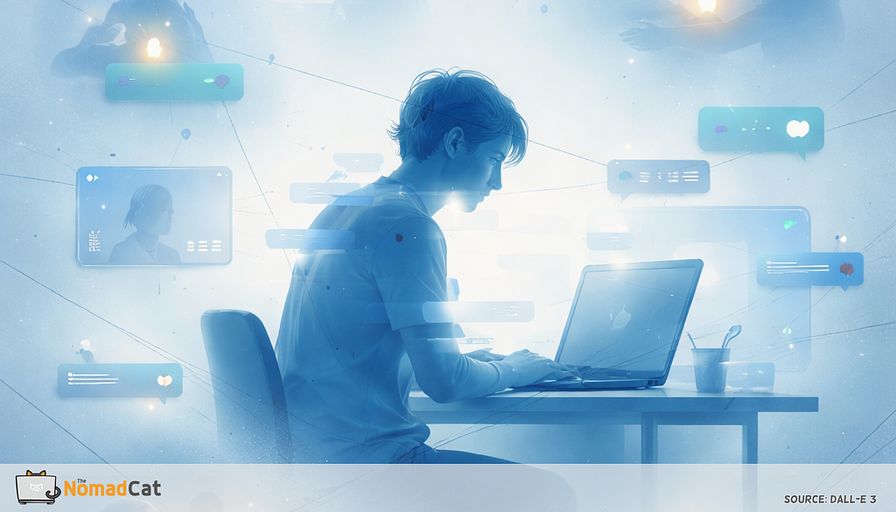
The calendar looks fine. Almost polite. A few calls, a couple of tickets, some messages that should be quick. And yet your body sits there like it’s waiting for the next interruption.
That “nothing was hard but I’m still drained” feeling is often treated like a discipline problem. Move more. Focus harder. Do less Slack. But a lot of remote days aren’t heavy, they’re fragmented. They keep you switching contexts while your nervous system stays slightly on guard. Video doesn’t help either. It can turn even a normal conversation into feeling a bit on stage. If you’ve done this from a desk in Berlin, then Lisbon, you know the special trick of feeling “on” all day and still being wired way too late.
This article is about a missing input that used to happen for free: tiny, low-stakes human contact that lasts 5–45 seconds and has no deliverable attached. A nod in the hallway. A 2-line joke while something loads. A quick “got it” with a half-smile. Not bonding, not “culture building”, just micro-social repair. Small downshifts that make work feel less like solo mode.
You’ll see why remote work quietly removed these moments, and what replaced them instead
- status signals, timestamps, “seen” receipts, camera tiles, the green dot
- a lot more interpretation and a lot less accidental ease
Then we’ll get practical, without turning it into a new etiquette project. Expect a few small replacements that fit inside real 10-hour desk days
- tiny scripts that reduce tone-guessing and telepressure
- simple channel swaps when text starts getting rewritten 6 times
- small boundaries after evaluative moments that don’t look like a fitness plan
- a 7-day, one-variable test to see if this is the missing piece for you
No perfect morning routine. No mandatory “connect more”. Just a systems view of why remote work can leave you wired at 18:00, and a few small inputs that can change the loop.
A workday input that quietly disappeared
Nothing is hard, but it still drains you. The day looks light on paper, yet the body stays slightly braced, like the day is a long meeting you forgot to leave.
Part of this is fragmentation. Microsoft’s Work Trend Index keeps pointing at how the day gets chopped into tiny slices—messages and quick pings threaded between meetings, so you’re never in one mode for long. Videoconferencing can also be a stressor, not only because of time spent, but because it keeps you “on stage” and forces constant self-management (Riedl, 2021).
A missing input is micro-social repair: ultra-brief, low-stakes contact, roughly 5–45 seconds, with no deliverable attached. It’s the tiny moments of positive relating that make work feel a bit more human, without effort.
In the old default, it happened by accident, many times. A 10-second joke before a 1:1. A quick “got it” with a half-smile. A two-line aside while a document loads. Small downshifts your system used to get for free.
Why your system misses those tiny contacts
Even mildly awkward office moments helped. The half-second “do I say hi or pretend I’m invisible” situation. The tiny negotiation of space and attention. Not because it was fun, but because it was low-evaluation and optional.
Things that used to happen without planning
- A 15-second desk-side clarification that saves 6 back-and-forth messages.
- A shared eye-roll when the printer does its usual performance.
- A corridor nod, no words, just signal received.
- A micro-joke in a doc margin, not a Slack thread that demands replies.
- A quick “thanks” when someone unblocks you.
Edmondson’s psychological safety work helps with the key detail. Low-stakes is the point.
Why awkward still counts
The mechanism is almost boring. A brief human exchange forces a tiny de-escalation, even if you don’t notice it. It nudges you back toward neutral. Often it shows up as physical stuff, like the jaw unclenching or shoulders dropping 1 centimeter.
Light human presence can reduce threat scanning and effort because the environment reads as less “solo survival mode” (Coan et al., 2006). In plain terms: when someone safe is nearby—even for a second—your brain spends less energy checking if everything is a problem. Broader social buffering evidence points the same way (Uchino et al., 1996).
One guardrail though. This cannot be coerced. Forced interaction triggers pushback. Reactance is a known effect (Brehm, 1966). Repair works best when it stays voluntary and small, not when it becomes a program.
A tiny reset in systems terms
Micro-social repair is not “move more” advice in disguise. It works more like a state-change marker.
In systems terms, these tiny boundaries, they act like small error corrections. Without them, fragmentation keeps switching tasks while your internal mode never properly changes, so small errors and tension build up. It’s the difference between finishing a task and actually feeling finished. Research calls this detachment, even in short doses (Sonnentag & Fritz, 2007). Not dramatic. Just enough to stop “always on” from becoming the default.
It is not a steps problem
This is not a standing desk argument. Plenty of people stretch, train, even hit their steps, and still end the day oddly wired. The missing variable is more specific: being constantly legible.
Remote work makes contact more explicit, more persistent, and more judgeable, especially on video. Bailenson (2021) and Riedl (2021) both point at the “on stage” effect, plus self-view pushing self-monitoring. So you can fix the movement layer and still feel like your nervous system never got the memo that the meeting ended. It’s not a discipline failure.
Role switching got compressed
In an office, role changes happened without effort. You walked to a room. You waited. You were briefly just a person who exists near other people, not a polished interface.
Remote work compresses all of that into one continuous professional surface. You go from deep work to a call by clicking a rectangle, and suddenly you’re visible, recordable, and expected to look attentive. There’s almost no anonymous 30 seconds where your face can drop back to neutral.
This also tracks with network findings. Yang et al. in Nature Human Behaviour report more siloed networks and fewer cross-group ties in remote settings. Not because people became antisocial, but because weak-tie collisions got removed.
The end-of-day “nothing happened yet I’m tense” feeling is often role-collision, not workload.
What remote work replaced it with
Remote work did not remove presence. It translated it into signals that can be interpreted and compared.
Status signals (the new hallway)
- The green dot
- The last active timestamp
- Reply speed
- “Seen” receipts
- Camera tiles
- Recorded meetings “just in case”
So instead of a quick human bump in the hallway, the default becomes light monitoring. Not evil. More like everyone is reading the log files because that’s what the system gives them.
Text persistence (why you keep drafting)
Text makes this weirder. It reduces real-time pressure, but it becomes persistent and revisable, which invites drafting. Walther’s hyperpersonal model helps explain the behavior shift: when text lets you edit and “perfect” yourself, you start polishing more than you intended to, and the message turns into a tiny performance.
Video load (mirror-plus-stage)
Then video adds the mirror-plus-stage layer. Bailenson (2021) points at persistent self-view and nonverbal overload as fatigue pathways; Fauville et al. (2021) also flags self-view as a contributor and suggests a simple lever: hide self-view.
Awareness cues do help coordination. Dourish and Bellotti’s CSCW work shows how status signals support timing and reduce unnecessary pings. The strain shows up when norms turn every delay into a story. Slow reply means disengaged. Camera off means disrespect. Away status means “not working.” That’s basically telepressure in a modern outfit (Barber & Santuzzi, 2015).
The symptoms that look like you but are not
Call it the wired but brittle day. You finish a couple of short calls and somehow you’re still tense. At 18:00 you feel oddly alert, like the workday never landed. Jaw tension after a 12-minute sync. And then that exact moment: cursor hovering over “Send,” shoulders up near your ears, rewriting one neutral sentence because it could be read three ways.
Then a downstream behavior appears that people misread as personality. Your written tone gets sharper. Not mean, just less generous.
Text is a channel where tone is easy to misread, and people overestimate how clearly their intent comes through (Kruger et al., 2005). Byron’s review on email miscommunication points to the same theme in organizations (Byron, 2008). Fewer cues means more room for interpretation. And tired brains fill that room fast.
So the cost of preventing misinterpretation rises as the hours pass. A small hypothetical example: re-reading the same Slack line 6 times, not because the sentence is complex, but because you’re trying to prevent it from sounding cold.
If response latency is socially meaningful, the brain starts running a polling loop. Did they answer. Did I miss something. Did I mess up the tone. Mazmanian et al. describe how flexibility can produce an autonomy paradox where availability expands (Mazmanian et al., 2013). Add fragmentation and after-hours spillover (Microsoft WTI) and the loop gets easier to trigger and harder to exit.
After a day of being interpretable, scrolling can feel like the only place where nothing is demanded. In recovery terms, it’s improvised detachment when detachment never happened during the day (Sonnentag & Fritz, 2007). After-hours tech use is also linked with worse sleep and next-day fatigue, with work–home interference playing a role (Lanaj, Johnson & Barnes, 2014; Derks & Bakker, 2014).
Small replacements that fit inside a real remote day
Put non-outcome contact back in
The criteria is boring on purpose. Optional. 5–45 seconds. No task attached. Ideally it reduces evaluation pressure instead of adding a new thing to perform.
A practical approach is to make latency and intent explicit so nobody has to run tone-guessing in the background. Short templates that don’t demand a reply
- Heads down til 14:45
- In a call, back soon
- Saw this, noted
- Will reply by EOD
- Parked for now
- Closed the loop, thanks
Telepressure is largely expectation-shaped (Barber & Santuzzi, 2015). These tiny signals are boundary negotiation made visible in a non-defensive way (Palen & Dourish, 2003).
One modality swap can also help. If a message is getting rewritten 6 times, it’s a hint the channel is doing the wrong kind of work. For nuance-heavy moments, an occasional voice note brings back tone of voice and can end a long text loop faster (Dennis et al., 2008). Use sparingly so it doesn’t become another stream people feel obliged to monitor.
Create tiny boundaries at home that do not look like fitness
After a call, especially a high-stakes one, a neutral closure line can act like punctuation. “Ok, done.” “Parking this.” Said off-mic. Slightly silly, but it’s a state marker, not an affirmation.
Then add a 20–40 second context shift after evaluative moments. Stand at a window or a threshold. Look at something at distance. Come back. Now add one more piece of “walk to the meeting room” friction: before you click Join, do a small loop to the farthest room (or the kitchen) and back—same path each time, no phone—then sit and join. It’s not exercise; it’s a physical scene change your system can learn.
Kaplan’s Attention Restoration Theory gives a clean mechanism for why a different visual scene can help attention recover (Kaplan, 1995). Ulrich’s work links window views with recovery outcomes in healthcare settings (Ulrich, 1984).
Scripts and a 7-day debug test
If video calls feel like being on stage (Bailenson, 2021), reducing ambiguity around availability does something similar for chat. It turns guesswork into a shared expectation.
Use blunt, normal lines
- “Back at :03.”
- “Replying in 10.”
- “Heads down 45, then I’ll check.”
- “Can we do audio for this one”
- “No need to respond tonight.”
Pick 1, not all. The point is to reduce interpretation, not to create a new etiquette layer.
Camera load is also a real lever. “Camera off today, still here” can prevent silence being read as disengagement. Hiding self-view is a surprisingly clean option, since Fauville et al. (2021) explicitly recommends it as a mitigation.
If someone is introverted or socially anxious, minimal tone plus predictable duration often works better than “more connection.” Chosen solitude can be restorative when it is autonomy-supported (Nguyen, Ryan & Deci; Coplan et al.). Belongingness has a variable dose, not a quota (Baumeister & Leary).
A 7-day one-variable test
For 7 days, keep everything the same except 1 thing. Pick one predictable high-vigilance moment per day (after a status meeting, before replying to a tense thread, right after a camera-on call) and insert one micro-social repair proxy or one boundary script. Same time window, same workload, one variable.
At 18:00, record a single 0–10 rating like “how braced does my body feel” or “how sharp is my internal tone.” Single-item stress measures can still be valid when used consistently (Elo et al., 2003). Patterns across days matter more than one dramatic Tuesday.
Treat the result like weak data, not a verdict. If the number shifts down even a little, you likely found a missing input. If nothing moves, that’s also information. It points back to bigger levers like meeting load, after-hours fragmentation (Microsoft WTI), or sleep, which tends to quietly dominate the whole chart.
If your remote day looks “light” but still leaves you wired at 18:00, it’s probably not a discipline issue. A lot of the strain comes from fragmentation and being constantly legible, on camera, in chat, in reply speed, in that little green dot. The missing piece can be smaller than most productivity advice admits: a few seconds of low-stakes contact, plus a bit of physical friction, so your nervous system gets proof that one mode ended and another can start.
You might be interested by these articles:


Build an interruption ecology for remote work so your body stops billing you at 18:30

Video calls kept the talk and killed the movement

Your habits are fine your calendar is the bug

Audio first gives your body permission to move on remote days

Bring back the out tray so remote work can feel done

Find your real risk dna for a tech career that fits you

Building digital trust through ethical leadership