 Gilles Crofils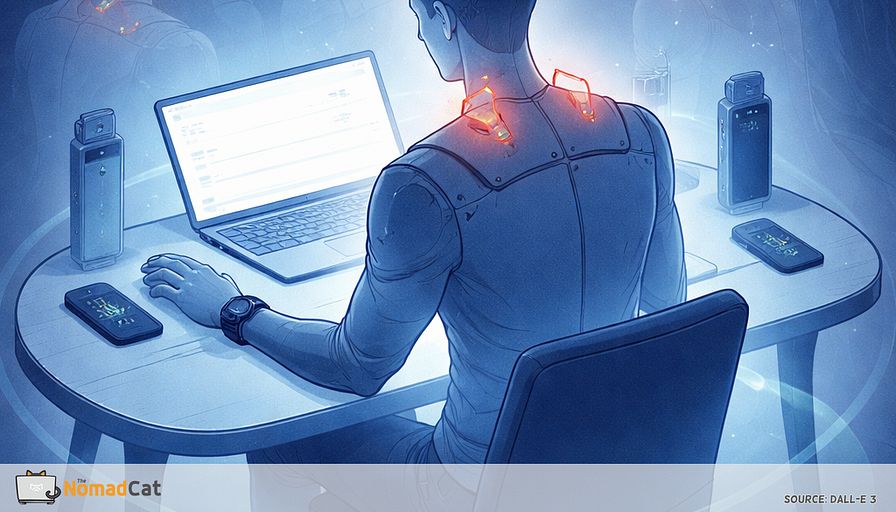
You can finish a 10-hour desk day with a clean inbox and a decent workout logged, then stand up and feel like your upper back got replaced by cardboard. Shoulders parked near your ears. Neck stiff. That same little spot in the low back doing its usual complaint around 18:00. It is annoying because, on paper, you did “everything right”. I get the same signal after late Lisbon desk nights: the work is done, and the upper back still invoices you.
This article is for that gap between “i trained” and “why do i still feel wrecked”. The missing piece is often not motivation, or a heroic 30-minute walk squeezed between calls. It is the tiny movement that normally happens inside work, between clicks, when you are not thinking about your body at all.
The idea has a boring name, static exposure. Too much time in the same shape. Most trackers see steps and workouts. They miss the micro-shifts that keep desk days tolerable. Ambient fidgeting is that posture variation that happens while work continues, small changes every 20 to 90 seconds, often without noticing.
Here is what we will cover, without turning your day into another system to manage
- Why “ambient fidgeting” is not exercise, but still matters for how your back and shoulders feel
- The difference between more movement minutes and better movement texture during long focus blocks
- How remote work quietly deleted a lot of normal reach, pivot, and posture variety
- Simple ways to spot when missing variability is the issue, plus a short stop-list for symptoms that are not a desk tweak problem
- A menu of camera-boring micro reconfigurations that fit inside meetings and deep work
- Small setup nudges that create movement without timers, streaks, or weird stretches on Zoom
The point is not posture perfection. It is getting your body to stop running the same background process for hours. Small inputs, low drama, and still compatible with a full calendar.
The motion you did not know you were doing
Ambient fidgeting is not exercise
You can have 1 of those days where everything looks clean. Inbox handled. Tickets closed. A 2-hour focus block with headphones. Maybe even a camera-on meeting where you barely moved, because moving feels like “not listening”. Then you stand up and it hits. Same screenshot stiffness. Upper back feels glued. Shoulders are up near your ears like they pay rent.
This can happen even if training is solid. Because what is missing is not motivation and not a heroic 30-minute walk. It’s the missing in-between movement.
The boring name is static exposure. The cost of holding the same shape too long, even if total daily activity looks fine on a watch. Most tracking sees big buckets like steps and workouts. It misses the small in-task motion that makes a desk day tolerable.
Ambient fidgeting is that unremarkable posture variation that happens while work continues. Micro-shifts every 20 to 90 seconds, often without noticing.
Office-native versions look like this
- turning 30 degrees to reply to someone
- reaching for a notebook, bottle, cable
- scooting your chair back 10 cm
- perching on the chair edge for 2 minutes
- half-standing to point at a screen
- shifting weight to 1 hip, then back
Ergonomics has a useful line here
“the best posture is the next posture.”
No magic frequency target. But the mechanism is pretty simple. Small posture changes redistribute which tissues are doing the low-level holding job. In practice it can feel immediate: if your forearms go from floating to supported, a lot of people notice the neck and shoulders stop doing as much background gripping. That is the point. Reduce “same tissue, same job” for hours.
Also, no need to get weird about it. This is not mystical fluid pumping. The safe claim is just load and activation changes.
This is why common advice buckets don’t fit well
- not posture perfection
- not becoming the person doing visible stretches on Zoom
It is variability that survives constraints.
Variation is the missing layer
Movement texture beats more minutes
That desk “debt” is mostly about time in the same shape, not intensity. You can hit 10,000 steps and still feel like someone replaced your upper back with a wooden plank, because the work blocks were long and symmetric.
A useful model is bandwidth vs latency. Steps and workouts are bandwidth (total movement). Movement texture is latency (how long your body waits before the next small change). Remote “cockpit” setups push latency up because the bottle/phone/mouse never move, even when bandwidth looks great on a watch.
If you can’t remember the last time you changed foot position or forearm support in the last hour, your variability is probably near zero.
What the evidence can safely promise
The safest promise is not “this will fix your back.” It is “this changes exposure patterns in a sensible direction, and many people feel better without work output collapsing.”
A practical certainty ladder
- Most consistent: you reduce uninterrupted sitting time by sneaking in more position changes
- Often but variable: discomfort improves modestly, not guaranteed
- Usually neutral: productivity is often unchanged
You still get the same work done; you just stop paying for it at 18:00 with that 1 angry spot.
Remote work deleted the fidget ecology
The reach radius got too perfect
The typical home setup is efficient like a cockpit. Laptop centered. Mouse right there. Water bottle at elbow distance. Phone within 20 cm. Everything inside a small reach radius.
Great for throughput. Bad for incidental pivots and reaches. Fingers and eyes do the work. The torso signs a non-aggression pact with movement.
This got more obvious for me after the Berlin years shifted from office days to mostly remote, plus workations across Europe on bad chairs and worse desks: the less the environment forces small reaches and pivots, the more “statue hours” pile up.
Laptop-only setups make it worse because they tend to lock everything into a narrow zone: screen, keyboard, and pointing device all in the same small line, so you default to the same shoulder and neck position for longer.
Stillness became good manners
On video, stillness reads as attention. Movement reads as risk. Your head leaves the frame, camera refocuses, someone assumes you are multitasking. So people become statues in high-stakes calls due to incentives, not personality.
Deep work adds another trap. Cognitive capture narrows the world to the sentence, the code, the spreadsheet cell. The body locks to reduce noise. Unfortunately, time-on-task is exactly where discomfort tends to build.
Timers often fail in remote reality. They add more admin and tend to fire at the worst moment. Event-based cues are usually more realistic because they ride on things already happening.
How to spot missing shape changes
The pattern is local and boring
The simplest test is what creates relief. Not the long-term story. The immediate debug signal.
Missing variability often shows up as predictable, local discomfort that repeats in the same place during long focus blocks, even when training is solid.
A quick non-diagnostic checklist
- upper back that feels stapled between the shoulder blades
- a 1-spot low-back ache that shows up around the same hour
- shoulders creeping up in meetings
- jaw hovering or clenching
- wrists and forearms tense around mouse and keyboard
- neck and shoulder tightness linked to how your arms are supported
That last one is not imaginary: arm support changes the job description for your neck and shoulders.
Relief comes from changing shape
A useful A/B check is whether relief comes from reconfiguration, not effort.
If a 10-second shape change reduces that “same spot” tension, missing variability is a plausible missing input.
When it is not a fidget problem
If symptoms are sharp, radiating, numb, or progressively worse, that is a different bucket than “i sat too still.”
A compact stop-list
- new bowel or bladder dysfunction, or saddle area numbness
- severe or progressive weakness
- persistent or spreading numbness or tingling
- severe night pain, unexplained fever, recent major trauma
- symptoms worsening despite reducing load and changing positions
Not drama. Just routing.
Swaps that fit inside real work
The replacement rule is variable swaps
The goal is to increase how many posture variables change per hour while work continues. Not longer movement blocks.
Useful variables are simple
- foot position
- sit depth
- arm support
- trunk angle
- head orientation
- gaze distance
A 3 to 10 second re-stack is small enough to not break the thread. It can happen while listening, rereading the same sentence for the 3rd time, or during the pause before hitting send.
No streaks. No perfection. Miss a few hours and nothing breaks.
Micro reconfigurations
These are tiny toggles, reversible, boring on purpose.
Feet and base swaps
- both feet flat to 1 foot slightly back
- feet wider, then back
- heels lightly tucked under the chair for a minute
- toes turned out a few degrees, then re-center
- small left-right pressure shift
- 1 foot on a low support, then switch later
- uncross legs, then later recross the other way
Pelvis and sit-depth swaps
- sit back with support, then later perch closer to the front edge
- tall-ish sit to slight slouch, then back
- slide hips 5 to 10 cm forward, then re-stack
- rotate the pelvis a touch forward, then neutral again
- move 1 sit bone slightly forward, then re-center
Arms and shoulders swaps
- elbows supported to 1 forearm lightly off the desk for a moment, then switch
- hands on keyboard to hands in lap for 5 seconds, then back
- swap which arm gets support
- mouse hand relaxes and opens for 2 seconds
- a small shrug up then let it drop, once
- widen shoulder blades slightly, then neutral
Head and torso orientation swaps
- glance past the left edge of the screen, then back
- same on the right side, later
- a small head turn without tilting
- brief far glance to a wall or window
- rotate the torso 10 to 20 degrees and return
Avoid the classic desk mistakes
- aggressive neck circles
- forced twists in the chair
- repeated end-range backbends over the chair
- “stretch through pain” experiments between 2 emails
Benign inconvenience beats willpower
Put 1 thing slightly out of reach
Put 1 frequently used object just outside the easy reach radius so the day quietly forces a small pivot or reach. Not a productivity tax. Just a gentle nudge.
Options
- water bottle
- notebook
- headphones case
- charger or cable
- small trash bin
- pen cup
Placement rule
far enough that you need a small torso rotation, not so far that you half-stand and crank your arm 40 times a day.
If it starts to feel like forced reps, move it back.
Add a micro-perch option
Add a second place to sit for 5 to 20 minutes that changes hip angle and arm support. Same room. Could be a different chair, a stool, or another corner of the table.
The point is posture diversity, not fancy gear. The behavioral win is that switching costs almost nothing, so it happens more often. Like having a standby server, you reduce friction when the main system gets stuck.
A 7-day debug without a spreadsheet
A simple signal beats a full dashboard
For 7 days, pick 1 symptom that usually shows up by evening. Something repeatable.
- upper-back tightness around 18:00
- jaw tension during the last meeting
- 1 low-back spot after long focus blocks
Keep it to 1 daily check-in. This is the same reason I like my Decathlon sport watch for runs: it counts the obvious stuff fine. It also happily applauds steps while missing the “statue hours” entirely.
The only rule is notice and swap
When you notice you are frozen, change 1 variable.
Feet position. Sit depth. Forearm support. Torso angle. Gaze distance. Anything from the menu.
Define success like a human. A win is not zero discomfort forever. A win is that discomfort becomes less predictable and less sticky. It arrives later, feels less sharp, releases faster when you stand.
If nothing changes after 7 days, that is also useful data. The missing input might be elsewhere, sleep debt, workload intensity, or a workstation mismatch that keeps loading the same areas no matter how much you fidget.
Guardrails that keep it safe and non-weird
Keep it gentle and reversible. If a movement increases symptoms, make it smaller or stop.
Same stop-list as above: if any of those red flags show up, get assessed. And keep the fidgeting flexible. The moment it becomes superstition or another system to manage, it turns into just more desk noise. The whole point is boring, workable variability that survives a full calendar.
If you finish a long desk day with a workout done and still feel like your upper back is made of cardboard, it is not a character flaw. Often it is just static exposure: too much time in the same shape, with your watch applauding the steps while your shoulders quietly file complaints.
The fix is not posture perfection or a timer that interrupts at the worst moment. It is movement texture: small, boring reconfigurations that happen inside real work blocks. Remote work shrank the reach radius and made stillness “polite”, so it helps to add benign friction, like placing 1 object slightly out of reach.
If the discomfort is sharp, radiating, numb, or escalating, that is a different bucket. Otherwise, this is mostly about getting a bit of the old office fidget ecology back—without turning your calendar into a rehab program.


