Abstract:
The article explains why some people can finish work yet still sleep lightly and wake “ready for a meeting that doesn’t exist,” arguing that the issue often isn’t bad sleep hygiene but a nervous system stuck in “competence mode” due to hyperarousal and poor psychological detachment. It frames modern knowledge work as constant micro role-switching—individual contributor, reviewer, manager, client-facing impression manager, firefighter, presenter—where “persona churn” and telepressure keep the body subtly braced (dry eyes, raised shoulders, clenched jaw) and the mind rehearsing socially appropriate replies rather than solving concrete tasks, so common fixes like shutdown notes, silencing notifications, or being told to “just relax” can miss the real mechanism. The author (a physics-trained, metrics-oriented person who tracks HRV and sleep) warns that sleep optimization can become its own performance trap (orthosomnia), and instead offers a simple “3-minute role exit packet” done right after the last evaluative interaction: name the role you’re leaving, define what “good enough for tonight” means, set a specific re-entry time window, and write a one-line definition of true urgency (optionally paired with brief paced breathing), with guardrails to prevent it becoming another elaborate routine. Finally, it urges seeking clinical help when sleep impairment becomes chronic or risky—highlighting CBT-I as first-line treatment—and flags symptoms like loud snoring, witnessed breathing pauses, or dangerous daytime sleepiness as reasons to stop self-experimenting and get properly assessed.
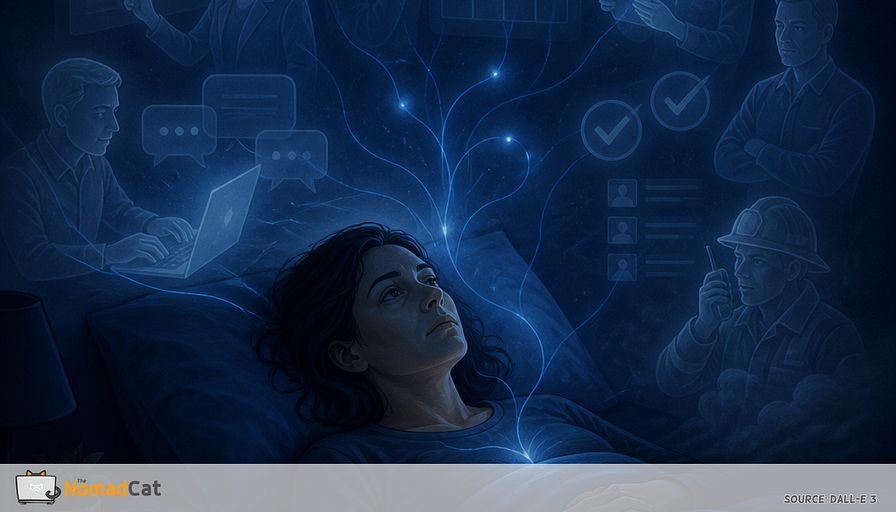
You close the laptop. The day is “done”. And somehow your body is still acting like someone might grade you. Dry eyes. Shoulders parked up near your ears. Jaw clenched in a way that feels normal until you notice it. Then bedtime shows up and the room gets dark, but your brain stays… logged in. Not panicky. Just weirdly ready. Like you’re on call for a meeting that doesn’t exist.
If that sounds familiar, the problem usually isn’t that you “forgot a sleep habit” or that you need a perfect shutdown checklist. A lot of the time it’s simpler and more annoying. Work ends, but your nervous system doesn’t switch profiles. You’re out of the inbox, but still in competence mode.
This article is about that lag, and what to do with it without turning sleep into another performance metric.
Here’s what you’ll get, in plain terms
- Why sleep can feel light and fragile even when you don’t feel anxious, and how the hyperarousal model explains that kind of “tired but still online” night
- The idea of role-switching residue, when the day is 8 small roles and your system doesn’t fully deconfigure after the last one
- A quick checklist to spot “persona churn” at night, in both thoughts and body cues
- Why common fixes (shutdown notes, turning off notifications, “just relax”) sometimes miss the real issue
- A small 3-minute role exit packet you can write before the evening leaks into bedtime, plus guardrails so it doesn’t become yet another job
- When it’s time to stop experimenting and get proper help, including the reality that CBT-I is a first-line option for chronic insomnia
No heroics. No perfect routines. Just a practical way to get your brain out of admin mode, so bed stops feeling like a stage and starts feeling like bed.
When work ends but your nervous system doesn’t
The evening that still feels like a status update
You close the laptop, the day is technically over, and yet something in you is still “composing.” You notice it in tiny moments: brushing your teeth while drafting a reply in your head, rewriting one sentence three different ways, keeping your face neutral in an empty room. Lights are off, but the system is still in admin mode.
It is easy to misread this as bad bedtime habits. Often it is more like leftover work settings that didn’t switch back. Sleep can go sideways without obvious panic. The hyperarousal model of insomnia fits this pretty well: arousal stays high even if it doesn’t feel like anxiety (Riemann et al., 2010).
The sleep signature of instant competence mode
Lights out comes with wakefulness that feels almost professional. You drift, but it’s light and breaks easily. Then you wake up and the brain boots straight into ready-for-the-meeting mode, even if the only meeting is with your ceiling.
The useful translation of “hyperarousal” is simple: your brain is still running daytime-speed signals at night, so you wake easily and re-enter alert mode fast (Riemann et al., 2010). The tell here is not fear. It is instant competence mode at night, and again on waking.
Role lag, not bad habits
The tired but still online night
Sometimes it is not the screen glow, open loops, or even acute anxiety. Someone can have decent boundaries, capture tasks properly, and still feel weirdly available at 11:47 pm. Like a support channel that never fully goes off duty.
A big piece is psychological detachment: the ability to stop being mentally at work after work (Sonnentag & Fritz, 2007). When it’s low, recovery is worse even if the day ended on paper.
Another piece is telepressure, the internal pull to respond fast even when nobody asked. If fast responsiveness was rewarded all day, the body can behave as if responsiveness is still being watched (Barber & Santuzzi, 2015).
A practical name for the combo is persona churn. The visible output stops, but the internal stance stays set to responsibility and being evaluated. And then there’s the replay loop: the mind cycling what could happen or what should have happened, with no new info arriving (Brosschot, Gerin & Thayer, 2006). If the off switch doesn’t trigger, sleep friction is not a moral failure. It’s a state that didn’t deconfigure.
The hidden meeting
Your day is not 1 job, it is 8 small roles
In knowledge work, the “job” is a fast loop of micro role transitions. You start as an individual contributor. Then reviewer. Then manager doing people-risk math. Then conflict smoother in a tense thread. Then firefighter when something breaks. Then presenter performing competence on demand.
Each role has different threat and reward cues. The day ends, but the settings don’t fully roll back.
Switching roles has a cost, even when you are good at it
Task-switching research shows switch costs: the brain doesn’t instantly reconfigure without a little residue (Monsell, 2003). In desk-work terms, that’s leaving an approval thread while still scanning for what you missed, already drafting the next message, and somehow carrying that “don’t mess this up” posture into dinner.
It can feel personal, like a character flaw. It is often just leftover state.
The roles that keep your system up even when you feel calm
That is why you can feel calm and still be physiologically up.
-
Reviewer mode is the last-minute doc review where you’re hunting for errors, and also quietly imagining how it looks if you miss one. Being evaluated (or feeling evaluated) can keep the stress system switched on (Dickerson & Kemeny, 2004).
-
Manager mode is responsibility scanning: what breaks if you miss this.
-
Client mode is impression management: tone-policing in a thread, staying polite in an exchange that doesn’t deserve this much diplomacy.
-
Firefighter mode is threat appraisal and triage.
- Presenter mode is the last meeting that involved evaluation, where you’re “on” until the second you leave the call… and then somehow still on.
Some days also include a lot of surface acting: keeping a steady tone, smiling through friction, staying polite in a tense Slack exchange. That effort is not free. And if detachment stays low, recovery gets blunted (Sonnentag & Fritz, 2007).
A quick check for role residue at night
The end of day role residue checklist
If shutdown notes and inbox zero don’t change your nights, it might not be a task problem. The question is not whether anything is unfinished. It is whether your stance is still set to available, responsible, and evaluable.
A quick reality check.
- Today required 6+ micro role switches inside 1–2 hours
- At bedtime, thoughts sound like lines you will say tomorrow
- You rehearse reasonable replies, not solutions
- You feel ready to respond, even with no notifications
- You wake and instantly boot into competence mode again
- Your mind loops what if or should have with no new info (Brosschot et al., 2006)
Role residue also shows up in the body. Subtle bracing. Jaw slightly ready to speak. Shoulders raised. Breathing shallow. Quiet, but not soft. This matches the hyperarousal framing where physiology stays elevated even without strong anxiety (Riemann et al., 2010).
A positive match does not mean you have insomnia. It means bedtime becomes the first real downshift attempt of the day. If sleep problems are chronic, severe, or paired with significant daytime impairment, talk with a clinician.
Why the usual sleep fixes miss role residue
Shutdown notes reduce open loops. They can help. One study found 5 minutes writing a to-do list before bed was linked with faster sleep onset than writing completed tasks, and more specific lists worked better (Scullin et al., 2018).
But that tool is built for tasks, not social readiness. A clean list does not switch off the part of you that was being evaluated all day. Some nights the loop is interaction rehearsal. If they push back, I’ll say it like this. That is still work, just invisible.
Telepressure also matters. If fast responsiveness was rewarded all day, the respond-now circuit can stay armed even when nobody pings you (Barber & Santuzzi, 2015). That is why turning off notifications sometimes helps, sometimes not. Silence does not always read as safety.
Also, telling someone to relax can land weirdly when they are not panicking. The issue is often not mood. It is that the work role never sent an exit signal.
A related trap is turning sleep into another dashboard. I studied fundamental physics at Paris University, I live in Lisbon, and yes, I track HRV/sleep with a Polar H10 and a Decathlon sport watch—so I know how easy it is for “data” to become “monitoring.” There’s even a name for when chasing perfect sleep data backfires: orthosomnia (Baron et al., 2017).
The 3-minute role exit packet
Do it before the day leaks into the night
By bedtime, the stance is already in your body. That’s why timing matters more than mood.
Do this right after the last socially loaded block of the day. After the last meeting that involved evaluation. After the last approval thread where you kept your tone professional. Not after you brush your teeth.
Detachment is where recovery starts, not in bed (Sonnentag & Fritz, 2007). Writing earlier in the evening can reduce pre-sleep arousal compared to keeping it for lights-out (Harvey & Farrell, 2003).
A small written boundary your brain can point to later
Set a 3-minute timer. Write. Stop when it rings, even mid-sentence. The point is not insight. It is making off duty legible.
-
Role I’m leaving now …
-
Good enough for tonight means …
-
Next time I re-enter this role is tomorrow at … for … minutes
- If something is truly urgent, it means … (1 line, concrete)
Naming the role reduces ambiguity. Good enough sets adequacy criteria, so the brain stops running silent tests at 1:30 am. The re-entry window helps because the replay loop loves open-ended maybe (Brosschot et al., 2006). The urgency line prevents the failure mode where everything starts to feel urgent once you’re tired.
Optional add-on if you still feel braced: 75–90 seconds of paced breathing at about 6 breaths per minute. Skip it if it annoys you.
Guardrails so this doesn’t become another job
On the days that already ate 10 hours of desk time, meetings, Slack tone-policing, and maybe the kind of day where you can work a full day without eating, drinking, or moving, the worst move is adding a longer perfect shutdown at night. Missing the 3-minute packet is not a reason to build a 20-minute bedtime version with extra steps and extra guilt.
A degraded mode is allowed. Even 30 seconds is enough.
Role I’m leaving now …
Next time I re-enter this role is tomorrow at … for … minutes
When it works, the change is subtle. Bed stops feeling like a stage. Waking up feels less like the brain boots straight into professional readiness, even if the night still has normal awakenings.
When to stop experimenting and get real help
If sleep is severely impaired for weeks or months, or daytime sleepiness starts making driving or work unsafe, stop piling on little fixes and get screened. For chronic insomnia, CBT-I is recommended as a first-line treatment in the ACP guideline (2016).
A few red flags worth taking seriously.
- Loud snoring most nights
-
Gasping or breathing pauses reported by someone else
- Dangerous sleepiness at the wheel
- Severe mood symptoms or escalating anxiety alongside insomnia
- Sleep getting worse despite removing obvious triggers like late caffeine
Desk work increasingly rewards anytime, anywhere responsiveness (Eurofound & ILO, 2017). If the environment won’t change this week, a tiny closure format can still reduce ambiguity about what happens next. The realistic win is less carryover. Fewer late-day role switches. Less of that evening readiness where your shoulders are still slightly up while brushing your teeth.
If your days are 10 hours of screens, meetings, tone-policing in threads, and maybe lunch at the desk, it makes sense that night doesn’t feel like a clean shutdown. The key idea here is simple: work can end while your nervous system stays in competence mode. That “tired but still online” feeling is often role residue, not a personal failure and not something you can fix by trying harder to relax.
The practical win is giving your brain a clear exit signal before bedtime shows up. A short role exit packet, with “good enough for tonight” and a defined re-entry time, can reduce the invisible monitoring loop. Not perfect sleep. Just a body that stops acting graded at midnight.
You might be interested by these articles:


Your brain needs an off duty signal not an earlier bedtime

A productive day can still break your sleep fix the missing downshift signal

Your workday ended but your brain is still on duty at 23:40

After dinner no more invisible work so your sleep can actually power down

Your 1st 45 minutes are training your 02:00 brain so change the input order

Lunch happened but your body stays online

Retirement saving for freelancers without the liquidity cliff