 Gilles Crofils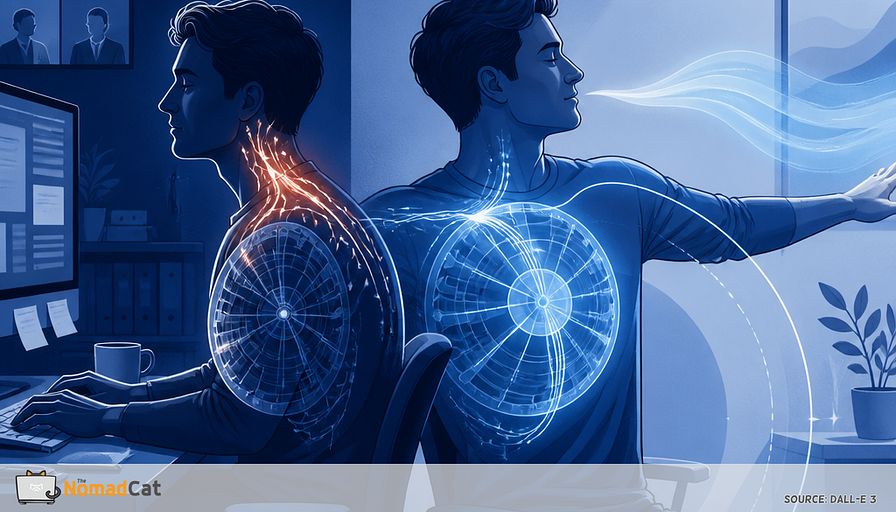
A desk day can look calm and still leave you feeling like you did manual labor. A few calls, a few tabs, lunch at the keyboard, then you stand up and your neck feels loud, your shoulders feel glued on, and turning to grab something behind you is weirdly heavy. It’s a frustrating mismatch, and it tends to come with a little guilt too, like “why am I tired, I barely moved.”
I’ve done this in offices in Beijing, then Berlin, and now Lisbon: still at the desk, often past midnight. Same pattern every time. The tightness in the upper back builds quietly until it forces me to move, even if the day looked “easy.”
This article reframes that whole pattern as a systems problem, not a personal failure. The issue is rarely “bad posture” in the screenshot sense. It’s more often low variety and one body region going a bit read-only for hours, forcing smaller regions to do overtime.
The working label here is desk-bound ribcage. Not a diagnosis—just a useful description of what happens when the ribs stay parked facing forward, breathing gets smaller, and the head and neck do most of the steering. From there, the piece walks through
- Why load sharing matters more than posture policing during long desk blocks
- 3 jobs the ribcage is supposed to help with turning, reaching, and breathing
- The quiet office behaviors that lock things in place, especially screens and meetings
- A 20 second “rib reboot” that’s subtle enough for camera-on and open office life
- A simple 7 day test to see if this is even your bottleneck, plus clear safety guardrails
No chair shopping guide. No fake “quick mobility” that turns into a workout. Just a small, repeatable input that fits inside a real calendar, and a skeptical way to check whether it actually changes anything.
Ribcage clocked out
The feeling of being used after doing nothing
You can do a full desk day that looks almost motionless on the outside. A few calls, a few tabs, lunch at the keyboard, then you stand up and your body reacts like it just carried boxes. Turning to grab something behind you feels weirdly heavy, reaching for a shelf is a negotiation. The paradox is simple. Low movement day, high worked feeling at 18:30.
This mismatch is common in office work. Desk-heavy jobs often come with neck, shoulder, and upper-back complaints. Discomfort also tends to creep up from morning to late afternoon. It is not a character flaw, it is an exposure pattern.
A more useful frame is variance over perfection. Not a posture lecture. Not a chair shopping guide. Not a workout plan disguised as quick mobility. The goal is narrower. Remove 1 repeatable bottleneck that makes other areas compensate.
A simple label helps. Call it desk-bound ribcage—a description of hours where the ribs stay facing forward, breathing gets smaller, and turning happens mostly through eyes and neck instead of sharing the work with the trunk. Two easy signs
- You swivel your head to find something on a second screen while the ribcage stays parked
- Your breaths are shallow enough that your shirt barely moves
When the ribcage is constrained, the neck has to contribute more rotation in order to look around. That is basic mechanics, and it explains a lot of that end-of-day neck and upper-trap noise.
A simple map for meetings
Load sharing beats posture policing
A desk day still asks you to turn, reach, breathe, and stabilize for hours. The core rule is boring but useful. When the ribcage does less, smaller regions do more and they complain sooner. The usual extra work lands in the neck, upper traps, low back, sometimes the jaw.
In work terms it is like when one service becomes read-only and traffic quietly reroutes to smaller services until latency spikes. At the desk, the ribcage goes read-only, so the neck and low back become the emergency path.
The fix is not one ideal posture screenshot. The more consistent driver is static exposure and low variety. This is why microbreak-style inputs show up so often. Short, frequent interruptions tend to reduce discomfort without asking for a lifestyle redesign. (And yes, it is a bit annoying.)
Three jobs the ribcage is supposed to share
Turning without making the neck do overtime
For the same look over there target, the geometry is almost unfair. If the trunk turns even a little, the neck has less turning left to do. If the monitor is 30° to the right and the ribcage gives 10°, the neck only needs 20°.
Desk setups often remove that trunk contribution by default. Hips stay planted, torso stays square to the keyboard, and the head does the steering toward a side screen or during thinking mode. A useful sign is the two-step turn. Head first, torso later.
Reaching without the shoulder hiking up
Reaching is cooperation. The arm is the tool, but the ribs and upper back are the base the shoulder blade needs to glide on. When the ribcage stays forward-only for hours, the system cheats. You see a shrug. You feel a pinch.
Some lab work suggests your upper back position can change how your shoulder blade moves when you lift your arm. In shoulder pain research, patterns vary a lot by person and task, so this is not a diagnosis. It’s just a reminder that shoulder sensations are often a base issue, not an arm issue.
A common fix that backfires is the cue “shoulders down and back.” It often increases bracing rather than giving you more options. The upper back can feel even more locked. Very office-life.
Breathing that does not climb into the neck
On meeting-heavy days, breathing often gets smaller without anyone deciding it. Shorter exhale, ribs held a bit up, voice-ready posture, and camera-on politeness that discourages shifting around.
Treat the next part as a hypothesis. On talk-heavy days, if the ribs expand less over long blocks, breathing effort can drift upward toward upper chest and neck muscles. It’s not guaranteed, but it’s a useful thing to test.
Still, breathing is a useful state-change lever because it is low friction. A slightly longer exhale can let the ribs drop a bit. That often reduces the held-brace feeling and makes turning and reaching feel less sticky.
The quiet behaviors that park the ribs
Screens create a forward corridor
Near-focus work narrows options even with a good setup. Eyes and head do constant micro-adjustments while the torso stays squared to the keyboard, especially with dual monitors where it feels efficient to keep typing position and rotate only the head.
Video calls also train polite stillness. Less fidgeting, less side-bending, less turning to reach something off-screen. It is a plausible amplifier, even if clean measurements are limited.
So the problem is rarely sitting. It is sitting in one direction for too long. Direction changes are the overlooked microbreak.
Precision mode makes the exhale shorter
There is a precision mode in normal work. Debugging, careful writing, a tense call. Breathing gets smaller and the exhale shortens. Over hours it stacks with the “hold yourself” posture that tends to increase bracing.
Big visible breathing rarely survives week 1 on camera. Not because anyone is weak, but because it is socially loud and high friction.
Symptom patterns that point to missing ribcage help
The two-step turn
After a long stretch of tabs and meetings, the head moves first like a periscope while the shoulders stay parked. If a tiny chair swivel or small torso turn makes turning feel easier right away, distribution is probably part of the story. Not a cure, just a clue.
If there is growing numbness or weakness, trouble with balance, or hand clumsiness, skip the self-tests and get assessed.
The reach that complains only at weird angles
Typing is narrow, forward, and symmetrical. Real life is diagonal and rotated. The shoulder can feel fine at the desk, then the seatbelt, back pocket, or overhead shelf creates a pinchy moment and the upper trap jumps in to help.
If the ribs stay lifted and forward for hours, the shoulder blade can start from a less friendly base. Then the system compensates with a shrug, a little low-back arch, or both.
The low back that needs to unzip after standing
A desk-native pattern is belt-like low-back stiffness when standing up, then 30 to 90 seconds of walking makes it fade. That quick change usually reads more like a state shift than damage. Repeatability across days matters more than one bad stand-up.
If there are bowel or bladder changes, saddle numbness, or progressive leg weakness, that is emergency territory. Bypass tweaks and get urgent medical evaluation.
20 second rib reboot
What it is and why it stays subtle
The 20 second rib reboot is a tiny sequence for seams you already have. End of call, hit Send, waiting on an export.
In my experience, the only breaks that survive real calendars are the tiny ones. Brief and frequent beats heroic. It also works better when the break is basically too small to argue with.
- Subtle enough for camera and open office
- Intensity stays below real stretching
- Goal is options, not performance
- Stop if sharp or radiating pain
Step logic
- Longer exhale can reduce the held-brace pattern
- Small torso turn restores load sharing so the neck does not do all the steering
- Diagonal reach brings back rib and shoulder blade cooperation that a straight-ahead typing day removes
Step A a quieter longer exhale
One quiet longer exhale, no big inhale before it. Let the ribs drop a little. Jaw soft. Avoid forcing shoulders down and back.
Camera-safe hiding spots:
- Exhale while rereading the last line before sending a message.
- Or: when the call ends and everyone does that half-second stare at the “Leave” button, let the exhale happen there—hands still on mouse/trackpad, eyes on the corner.
Step B turn the chair with the torso
Keep it small. Rotate the torso and chair together a little left, then right. Aim to feel the ribs move under the shoulder blades. Not a neck twist. Any trunk rotation you add reduces required neck rotation for the same look-there task.
If turning brings strong tingling, radiating pain, or clear neurological symptoms, stop and get assessed.
Step C a diagonal reach led by the ribs
From that small rotated position, do a small diagonal reach as if placing something on a shoulder-height shelf in front of you, then switch sides. Let the ribs initiate the direction, the arm follows like a tool.
Classic mistakes
- Forcing shoulders down and back
- Reaching too far so it becomes exercise
A good signal is the shoulder blade feels like it slides rather than hikes. If the neck grabs, the reach is probably too big or the breath got held.
A 7 day test for skeptical professionals
Pick 1 output and keep it boring
Bodies are noisy systems. Fewer metrics usually gives a cleaner signal.
Pick 1
- Stand up recovery time, seconds until your back feels normal after standing
- Neck busyness after calls, a 0 to 10 rating right after a call block
- Reach pinch check, seatbelt or back-pocket reach feels pinchy, yes or no
If you track discomfort, treat it like signal vs noise. As a rough threshold (not a promise), changes around ~1.5 to 2 points on a 0 to 10 scale are often treated as meaningful in pain scoring, while smaller wiggles can just be day-to-day variance.
A protocol that fits inside a real calendar
Run it for 7 days. Do the 20 second rib reboot 3 times per day, tied to the same seams such as after the first call block, after the post-lunch send moment, and at end of day.
To keep the result believable, avoid changing other big variables this week
- No new workouts
- No chair upgrade
- No 30 minute night stretching marathon
Interpretation rule. Look for smaller extremes, not perfect days. No change is still data. It may mean this was not the bottleneck, or that workload density and general stress are doing more of the driving that week.
Safety guardrails before you blame the desk
Most desk discomfort is boring and reversible. Pause experiments and get prompt medical evaluation if you have any of the following:
- Progressive weakness in an arm or leg
- Worsening numbness or loss of feeling
- New trouble walking or balance changes
- New hand clumsiness
- Bowel or bladder changes
- Numbness in the groin or saddle area
- Severe pain that does not let up even at rest
- Fever or feeling systemically unwell with spine pain
- Recent trauma or a fall especially with osteoporosis or steroid use
What is solid here is fairly simple: brief extra breaks can reduce computer-work discomfort without hurting performance; trunk rotation reduces the neck rotation requirement for the same visual target; and upper back position can change how the shoulder blade behaves during arm lifting.
What is more of a working guess is that tiny trunk rotation reliably reduces neck muscle activity during real desk tasks, that camera-on meetings measurably reduce trunk motion, or that this rib reboot prevents pain long term. The honest move is to treat those as hypotheses and test low-risk changes.
If symptoms feel worrying, rapidly worsening, or not clearly desk exposure, assessment beats more experimentation.
If a desk day leaves you feeling worked over, it is usually not because you “sat wrong.” It is more often the same direction all day, the same small breaths, and the ribcage quietly clocking out while the neck and low back cover the shift. The useful move here is load sharing, not posture policing. A tiny interruption can change the routing.
That is why the 20 second rib reboot matters. One longer exhale, a small torso turn, a modest diagonal reach. Nothing dramatic—just enough variety to give turning, reaching, and breathing more options again. Usually the first change isn’t “no pain,” it’s that turning feels a bit less expensive.


