Abstract:
The article explains why people can finish work at a reasonable hour yet still end up awake at 01:00: when a day is packed with meetings, pings, “quick” requests, approvals, and constant task-switching, it creates an “autonomy debt,” so nighttime becomes defended territory—the last boundary no one can schedule over—and staying up is less about screens or even fun and more about reclaiming a sense of ownership. It distinguishes this autonomy-rebound delay (it feels like a choice you don’t want to give up) from rumination (you try to sleep but your mind won’t stop) and circadian delay (you simply aren’t sleepy for weeks), arguing that generic wind-down advice often fails because the problem started earlier than bedtime. Instead of “try harder at 22:30,” it proposes small upstream fixes: a brief “agency deposit” of 15–25 minutes in the early evening that is self-chosen, non-escalating, and interrupt-resistant (e.g., 10 pages of a book, a short walk loop, a small sketch with a clear stop cue), plus one daily, specific “not now” at work to reclaim schedule control (like a closed calendar block or a concrete reply time). It suggests lightweight self-checks (intended vs. actual bedtime and a quick “would going to bed now feel like I had no life today?” prompt) and notes red flags where professional evaluation or CBT-I is more appropriate, reframing late-night sleep delay as a solvable configuration issue rather than a moral failure.
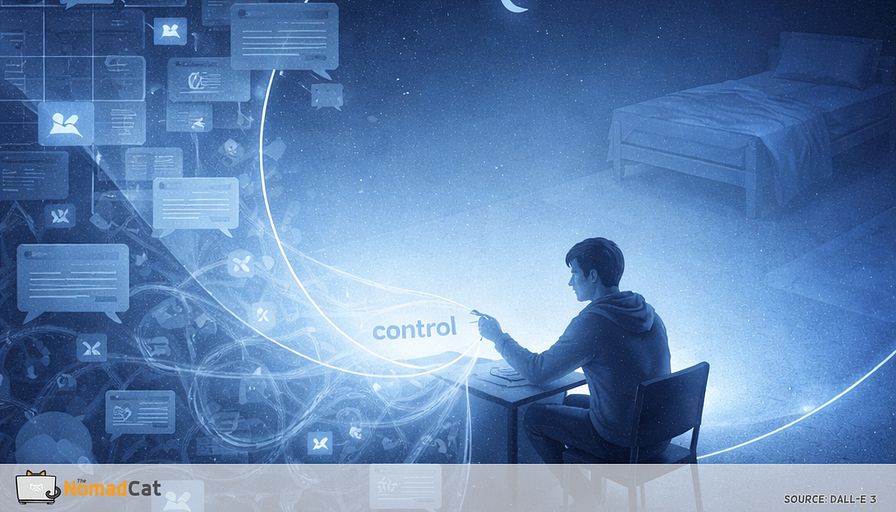
You close the laptop at a reasonable hour. The day is done, technically. The room is quiet. And somehow you’re still awake at 01:00, doing something that isn’t even that fun. It’s not that you’re falling apart. It’s not always your phone, either. More like the first time all day nobody can ask you for anything, and you don’t want to give that up yet.
I’m writing this as a French person who’s been doing desk years across Berlin, Beijing, and now Lisbon (since 2023), and the pattern is annoyingly consistent: the later it gets, the more “mine” it feels.
This article is here to name that loop, and to move it out of the “bad discipline” bucket. The idea is simple. When your day is full of demands and low on control, your brain tries to get some control back at night. Bedtime becomes the last boundary nobody can book, so sleep gets delayed to stretch the only time that feels like yours.
What we’ll cover, without turning this into a spreadsheet you hate:
- Why wind-down tips can feel useless when the problem started at 10:00, not at 22:30
- The difference between autonomy-debt delay, rumination, and circadian delay, so you don’t debug the wrong thing
- A tiny “agency deposit” you can place earlier in the evening, designed to reduce the late-night pull without adding more rules
- A couple of boring, realistic guardrails for busy desk days, where perfection is not the assignment
Think of it like a system throwing errors. The fix is rarely “try harder at bedtime”. It’s usually one small configuration change upstream, so sleep doesn’t have to carry the whole weight of being your only piece of freedom.
The loop has a name
When the day ends but your brain refuses to go to bed
A normal desk day runs 10 hours. Meetings, tabs, pings, tiny approvals, docs you can’t edit, so you copy paste like it’s 2009. You close the laptop at a reasonable time. The room gets quiet. And then you don’t go to bed.
Not because you’re spiraling. Sometimes you’re not even scrolling. Often it’s simpler: finally, nobody can ask anything from you. It’s a quiet refusal, almost polite.
There’s a basic work idea behind this. When demands are high and control is low, strain goes up (Karasek, 1979) — meaning the same workload hits harder when you don’t get to choose how you do it. The late night starts to look less like “bad discipline” and more like a delayed reaction to a day that wasn’t really yours.
Autonomy rebound in 4 beats
- The day is externally owned, scheduled, interrupted, measured.
- The evening becomes the first self-directed resource window all day.
- Bedtime is the last boundary that nobody can book over.
- Sleep gets delayed to stretch that boundary.
Kroese et al. (2014) calls this bedtime procrastination: going to bed later than intended without external reasons. What’s tricky is the reward is often not the activity. It’s the control you feel while doing it.
It’s not about screens, it’s about ownership
This is why the late night can look “responsible” and still be the same loop. You can clean the kitchen at 23:30, read a paper book, work on a hobby with your phone on airplane mode, and still push bedtime.
If the night feels like “mine”, almost any activity can become the vehicle. Screen light is a separate mechanism. Blue light can shift sleep biology (Chang et al., 2015), but time displacement and ownership can delay sleep even with zero screens.
Quick contrasts
These patterns can overlap, but they feel different.
- Autonomy-debt delay feels like choosing. You could go to bed, you just don’t want to end the only boundary you control.
- Rumination delay feels like noise. You are in bed trying to sleep, but your brain keeps replaying and forecasting (Harvey, 2002).
- Circadian delay feels like biology. You’re tired tomorrow, but not sleepy now for weeks, which can fit a delayed sleep-wake phase pattern (ICSD-3, a clinical sleep classification manual).
If you treat all of these as “i need a better wind-down”, you often target the wrong layer.
Why wind-down advice keeps missing
The problem starts before 22:30
Sleep hygiene is often treated like a patch you apply at night. Dim lights, no caffeine, a book, breathing. Fine. But if the drift was built earlier, a bedtime-only patch can stay weirdly ineffective.
That mismatch makes people quietly angry. You do the “right” things and still see 01:00. Also, sleep hygiene education alone is usually weak as a stand-alone treatment for chronic insomnia (Sateia et al., 2017). The fix is rarely only a nicer bedtime.
It’s not discipline, it’s an autonomy budget
Think of it like borrowing time at interest. You borrow control all day, tiny loans, every ping and meeting and “quick sync”. You repay it at night by staying up.
If autonomy is missing from 09:00 to 19:00, your brain tries to buy it back after dinner. Bedtime is the easiest place to take it from.
Schedule control beats extra rituals
There’s a practical bridge here. When people get more control over their schedules, sleep can improve without adding fancy bedtime rules. In the STAR workplace intervention, increasing schedule control and supervisor support improved objective sleep measures (measured by a tracker, not just self-report) (Olson et al., 2015). Less “do this at 22:15”, more “stop making the entire day feel bookable by other people.”
Autonomy debt in plain words
A ledger, not a personality trait
Autonomy debt is the gap between how much choice you needed during the day and how much choice you got. Not a character flaw. More like a running tab. I’m calling it autonomy debt because it behaves like a tab: ignore it all day, and it shows up at night with interest.
Example. You planned a 2-hour focus block. Then a “quick review” lands at 16:40, with a 17:15 meeting to discuss it. Now your focus block becomes a patchwork. Nothing dramatic happened. But the day took another bite of agency.
The quiet erosion of 40 small yeses
It often produces a specific end-of-day tone. Not classic anxiety. More like you were “available” all day and now your brain wants compensation.
- A meeting appears where your break was.
- A “2 min question” becomes 25 minutes.
- A doc returns with surprise comments.
- Another tool pings you, again.
- You rewrite the same paragraph 3 times.
- You switch tasks, then forget why.
- You re-open Slack “just in case”.
- You say yes, to keep things moving.
You get a day that feels busy without ever feeling complete.
Why nights become defended territory
At night the irritation shows up as “tomorrow starts too soon”. Bedtime becomes a boundary you can defend, because nobody can schedule over it.
And you can feel it in the body: heavy eyes, tired shoulders, but the mind is oddly lit up, like it refuses to power down.
The delay is often protecting a feeling of being a person again, not just chasing entertainment. You may even pick calm activities and still resist sleep, because the relief comes from choosing.
Telepressure can amplify it, that internal push to respond quickly and stay reachable (Barber & Santuzzi, 2015). Even your free time can feel pre-interrupted.
A fast diagnosis without apps
A 3-evening check
This is not tracking everything. It’s 10 seconds.
For 3 evenings, write:
- Intended bedtime
- Actual bedtime
That gap is basically the Kroese et al. (2014) definition. Short notes beat memory. Sleep research uses simple diaries for a reason.
Add 1 feeling question above the times:
If i went to bed now, would i feel like i had no life today
Then separate finishing from choosing.
-
Staying up to finish
- Cleaning up the last Slack messages so tomorrow doesn’t start on fire
- Rewriting a paragraph “one last time” because your head won’t let it go
-
Staying up to finally choose
- Watching something random because nobody can interrupt
- Doing a slow quiet hobby task because it’s yours and has zero KPI attached
If you see a big intended vs actual gap plus a strong “no life today” feeling, autonomy debt is a good suspect. If you’re stuck awake in bed even when you try, or you can’t shift earlier at all for weeks, another driver may be louder.
The replacement test
On 1 evening, insert 30 minutes of uninterrupted personal time around 17:30 to 19:00. Then see if the late-night pull drops.
This targets control earlier, not screens later. Direct RCT evidence for “earlier leisure blocks” as a standalone technique is limited, so treat it as personal R&D, not doctrine.
The fix is an agency deposit
Deposit rules that survive a real desk day
An agency deposit is a tiny block, 15–25 minutes, placed end of workday or pre-dinner, before you’re fully depleted. The point is to move a bit of control earlier so bedtime doesn’t have to carry the full weight of being your only unbookable boundary.
To work, it needs 3 constraints.
-
Self-chosen
- If it turns into life admin you “should” do, it can feel like more compliance, not ownership.
-
Non-escalating
- Avoid activities with no natural stop point. Bedtime procrastination is an intention-behavior gap (Kroese et al., 2014), so pick things that end cleanly. For me that means “10 pages” beats “start a new thing”, almost every time.
-
Interrupt-resistant
- If it can be preempted, it doesn’t restore control, it rehearses compliance.
To make it interrupt-resistant, use one simple guardrail: put a “busy” hold in your calendar or physically move your phone to another room.
A stop cue helps. If–then planning is the boring tool here (Gollwitzer, 1999).
- If the timer hits 20 minutes, then i stand up and transition.
- If the kettle boils, then the deposit ends.
Keep it from becoming another task
Predictable failure mode: you start “improving” the deposit, then you hate it, then you reclaim the night again. Very efficient, in the worst way.
Keep the menu low-setup and non-performative.
- Read 10 pages
- Sketch for 15 minutes
- Sit outside, no phone
- Water plants, quick gardening check
Also: if you miss a day, ok. It happens. Just don’t make it dramatic.
The content matters less than the control.
One small lever inside the workday
A daily not now
The easiest upstream lever is a calm not now with a return time. Not a rebellion. Just 1 proof per day that you still have time authority.
Vague replies create ping-back. Be specific.
- “I’m heads-down until 15:00, drop it here and I’ll reply.”
- “Can do. Tomorrow by 11:00 is realistic on my side.”
- “Not now. If it’s urgent, ping me. Otherwise today 17:30.”
This gets extra important when you’re leading people across time zones: if you behave like you’re always on, the system learns to treat you like an always-on resource.
If scripts feel socially hard, use a boring closed block.
- Put a calendar hold like “Closed block 14:00–14:45” and keep it recurring.
- Set a status message like “Back at 14:45, call me only for urgent.”
- Define 1 escalation channel for true emergencies.
Less fragmentation in the day usually means less autonomy debt at night.
Boring guardrails
Progress without perfect sleep
If you like tracking, keep it tiny. Focus on trend, not purity. Think incident monitoring: you’re watching whether alerts are going down over time, not demanding zero alerts forever.
- Fewer accidental 01:00 nights
- Less bedtime resentment
- Less “tomorrow starts too soon” right before bed
A lightweight 7-day check, no apps:
- ☐ Agency deposit happened (15–25 minutes, self-chosen, bounded)
- ☐ 1 daytime control token happened (not now or a closed block)
- ☐ Bedtime delay happened (actual later than intended)
If 2 weeks ago it was chaos and now it is only chaos on Tuesdays, that counts.
Limits and red flags
If sleep is broadly impaired, structured treatment beats more micro-tweaks. Chronic insomnia is typically framed as ≥3 nights per week for ≥3 months with daytime impairment (ICSD-3).
If you want quick screeners, the Insomnia Severity Index (ISI) or the Pittsburgh Sleep Quality Index (PSQI) can help clarify severity. For chronic insomnia, cognitive behavioral therapy for insomnia (CBT-I) is recommended as first-line treatment in guidelines like the American College of Physicians guideline (Qaseem et al., 2016).
Some things are not “debug it yourself” territory. Get evaluated for red flags like:
- Loud snoring plus gasping or witnessed apneas, especially with daytime sleepiness (Kapur et al., 2017; NICE NG202)
- Dangerous daytime sleepiness, near-misses while driving, dozing at work
- Injurious parasomnias, unusual nighttime behaviors that could be seizures
- Sudden weakness with emotions, hallucinations around sleep, narcolepsy-like signs
The point of this framing is not guilt. It’s clarity. If sleep feels like a system that isn’t configured yet, you stop moralizing the errors and you can finally change the right setting.
Some nights you’re not chasing entertainment. You’re defending a small piece of agency — and sleep is just the place you’ve been paying for it.
You might be interested by these articles:


A productive day can still break your sleep fix the missing downshift signal

Thin sleep is a workday monitoring bug not a bedtime failure

Sleep looks fine but your brain never downshifted

8 hours in bed and still tired debug your fragmented sleep

Your 1st 45 minutes are training your 02:00 brain so change the input order

Harnessing Nature for Energy Innovation

Empowering Tech Ventures Through Support Hubs