Abstract:
The article explains why remote work can leave you feeling mentally “on-call” even after a seemingly perfect day—answering threads, dropping links, creating tickets—yet still half-refreshing Slack at 19:40 because your brain lacks proof that a handoff truly landed. It argues this isn’t a motivation or discipline problem but a small coordination “bug”: remote text channels often omit the quick, semi-public office “handshake” that provided three signals—receipt (“I saw it”), ownership (“I have it”), and next step (“here’s what happens now”)—so tasks stay unresolved in working memory and trigger vigilance, tone misreads, and repetitive checking loops that create attention residue and even a physical monitoring posture (tight jaw, raised shoulders). Instead of pushing “more communication” or faster replies, the piece proposes “clearer closure” via short 1–2 line “closure pings” that explicitly state receipt plus an ETA (e.g., “Got it—reviewing after the 15:00 call, back by 17:30”), ownership statements, and a compact decision format (“Decision: X. Owner: Y. Next: Z. ETA: time”), with guardrails to avoid noise. It ends with a deliberately boring 7-day test: pick one trigger (like any blocking delegation), add a closure ping each time, and nightly check whether you hovered and refreshed less, carried fewer “waiting for X” tabs in your head, and ended the day with fewer socially unclear loose threads—aiming for fewer background processes, not more talk.
You can do everything “right” on a remote day and still end it with that low-grade hum in your head.
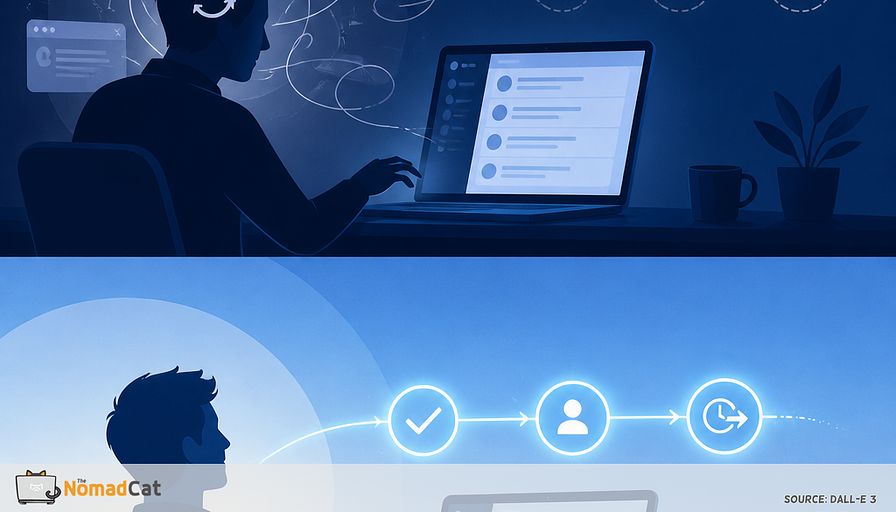
The thread is answered. The link is in the doc. The ticket exists. Someone reacted with a thumbs-up. And yet, later, you’re still half-checking Slack. Refreshing once. Then once more, just to see if the thing moved. Not because you love chaos. Because your brain is waiting for proof that the handoff actually happened.
This article is about that missing proof.
Not in a motivational way, and not in a “try harder to detach” way. More like debugging a small coordination bug that quietly creates vigilance, extra checking, and that annoying feeling of being on-call when you’re not.
Here’s what you’ll get, in plain terms
- why silence in text channels starts to feel like a signal, even when nobody meant anything by it
- the 3-part “handshake moment” your brain used to get for free in an office, and why remote work drops it
- how missing acknowledgments keep tasks stuck in working memory and pull attention back into refresh loops
- a small set of phrases and a 7-day test to make closure visible, without adding a whole new system
If remote work sometimes feels oddly sticky, this is probably not a discipline problem. It’s a missing “got it” problem. And it’s fixable with small, almost stupid changes that make the state clear, so your brain can finally drop the thread.
The missing proof of handoff
The 3-second proof your brain used to get for free
You can have a remote day that looks clean on paper. Threads answered. Links dropped. Tickets created. A decision implied with a thumbs-up. And still, there is this tiny hum in the background. Not panic. More like waiting on a loop.
You keep half an eye on Slack. You refresh the doc once. You check the issue again, just to see if it moved. Your shoulders stay a touch high, like you’re not fully allowed to land.
That sticky feeling is rarely a time management problem. It is often a confirmation problem. Response delay is not neutral in our heads. It gets interpreted socially, even when nobody meant anything by it (Kalman & Rafaeli, 2011).
A handshake moment is a tiny micro-interaction that carries 3 things
- Receipt I saw it
- Ownership I have it
- Next step here is what happens now
In an office, this happened in simple, semi-public ways, which made it believable. Got it, I’ll take it in front of 2 people. A nod while you point at the printout. Someone repeating the task back before turning to their screen. It’s basic evidence that the message landed.
This is also why the issue is not personality based. Think of it like networking. Offices had more acknowledgments. You sent something, you got a clear “received,” and your brain could drop the thread. Remote work has more sends with missing confirmations, so the sender keeps the thread open and keeps polling.
Working memory is limited (Baddeley, 2000). Unfinished goals intrude, and making a plan reduces the intrusion (Masicampo & Baumeister, 2011). Without a clear acknowledgment, the plan stays fuzzy, so the goal keeps knocking.
Why silence feels like a signal
Silence makes your brain write the missing parts
Text strips out the cues that used to come with a request. No nod. No quick face that says yes. That absence becomes an information gap. Then the delay itself starts to look like a message (Kalman & Rafaeli, 2011).
So people follow up, monitor, reopen tabs. Your brain hates missing data.
Tone drift is normal, so explicit receipt is safer
In text, senders often think their intent is clearer than it is, especially for emotion and sarcasm (Kruger et al., 2005). A short ok can read as annoyed. A detailed answer can read as passive aggressive.
A boring fix works. Explicit receipt plus a simple ETA reduces weird interpretations before they grow legs.
Trust becomes process-dependent
Remote teams often run on swift trust, the temporary trust people grant before they have real evidence (Jarvenpaa & Leidner, 1999). In text-heavy setups, that trust is more fragile unless teams compensate with clear, visible behaviors.
So small norms like receipt, owner, next step end up doing more work than they should.
The read receipt trap and the 1-line fix
Read receipts look like a fix because they answer did you get it. But seen without ownership or next step can create a weird pressure dynamic. You send a draft, it shows seen, and then silence again.
A 1-line human response does more work
Got it. I’ll review after the 15:00 call and reply by 17:30.
The cost of missing loops is not just more messages. It is vigilance.
Vigilance is the hidden tax
The no-receipt loop that turns into checking
The loop does not just steal minutes. It messes with attention. Debug it like a flaky network
1) You send a request with a dependency
2) No explicit receipt arrives, so the state stays unknown
3) Uncertainty spikes, so you do a quick check
4) The check gives small relief, then fades
5) Because relief is real, the brain repeats the check next time
Checking can stick because it briefly reduces discomfort (Abramowitz et al., 2009). Device checking patterns show similar loops (Oulasvirta et al., 2012).
Even if you don’t answer the message, a quick Slack glance still flips you into “stand by.” Across studies, interruptions and even notifications you ignore are linked with slower restarts and higher stress (Leroy, 2009; Mark et al., 2008; Stothart et al., 2015). Today, watch for the restart cost: after a “just checking” glance, how long until you’re properly back in the task?
This is what it looks like
- refreshing Slack or the doc just to verify
- rereading the sent message to see if it was unclear
- hovering in a thread, waiting for typing dots
- starting a new task, then bouncing back to the dependency 2 minutes later
- feeling oddly unable to leave the desk until someone replies
If this is familiar, it is probably missing closure signals, not weak willpower. When checking frequency goes down, stress often goes down too, even without changing workload (Kushlev & Dunn, 2015).
How monitoring turns into a posture
Monitoring has a physical profile. Shoulders slightly up. Jaw not fully resting. Breathing a bit shallow. One hand parked near the mouse like it is waiting for a bell. Telepressure, the urge to respond quickly (that itchy feeling you must reply fast), is a real thing (Barber & Santuzzi, 2015).
And here’s the remote-work detail that’s easy to miss: when handoffs are unclear, you stay seated “just in case.” You postpone the quick kitchen refill, skip the two flights of stairs, delay dinner by ten minutes because you might need to respond. The day doesn’t end; it smears. Missing acknowledgments don’t only create mental loops, they quietly remove the little physical separators your body used to get for free.
A simple log signal is jaw fatigue or daytime clenching. Not medical advice. Patterns vary a lot. But it can be a decent indicator to notice.
If the bug is missing closure, generic move more fixes are often aimed at the wrong layer.
Why generic fixes miss the bug
Timers do not survive a calendar that fights back
Microbreaks help on average (Kim, Park & Niu, 2017). The problem is the real day. Back to back meetings, reactive pings, someone just needs 2 mins. The timer goes off, you snooze it like it is a smoke alarm with commitment issues.
Then you stand up, drink water, come back, and the same dependency is still floating. So vigilance resumes instantly.
The variable is closure certainty
Shutdown rituals can support detachment (Sonnentag & Bayer, 2005). But shutdown does not pay down the confirmation debt from earlier. If loops are still socially open, the mind keeps them warm.
Treat this as coordination hygiene, not productivity theatre. My bias here is very much physics/epistemology flavored: reduce uncertainty, make the state observable, and the system behaves better.
Closure pings
Clearer closure is the fix. Not more messages. Not faster replies.
Make the state clear, not fast
You do not need to reply fast. You need to make the state clear. After years of running teams across time zones—Beijing, then Berlin, now Lisbon—I’ve learned the nervous system hates undefined handoffs.
Remote-first handbooks tend to encode boring but stabilizing norms like a single DRI for each piece of work, plus an explicit ETA for the next update (GitLab Handbook; Basecamp REMOTE). When ownership and timing are visible, coordination gets cleaner, and the nervous system stops doing background polling.
Clarity is not neediness
This is not reassurance seeking. It is ambiguity control, and it is usually kinder to everyone because it reduces follow ups. If needy is the fear, keep the message task-shaped and low drama. That also limits tone misreads (Kruger et al., 2005).
3 tiny pings that let people stop monitoring
A closure ping is a 1 to 2 line response that carries receipt plus a timeline, so the sender can drop the thread instead of keeping it in working memory.
Receipt helps, but ownership prevents duplicate work and chasing.
MVA receipt
Got it - will reply by [time].
(or) Got it - reviewing after [event], back by [time].
(or) Seen - will take a look by [time].
Many teams also use a reaction as receipt for FYI items. It only works when the meaning is agreed. And it still needs an ETA when someone is blocked. Seen alone is just suspense with better typography.
Ownership is the anti-chase technology
- “I’ll take this. I’ll update the ticket by 16:00.”
- “On it. Next update in this thread after I test, by EOD.”
For decisions, use a small format that removes we all assumed errors
Decision ping
“Decision: [X]. Owner: [name]. Next: [task]. ETA: [time].”
Example
“Decision: ship with feature flag. Owner: Lea. Next: create rollout plan in Jira. ETA: tomorrow 11:00.”
Where it fits in a real day
To make it automatic, attach it to existing seams
- after delegating work that blocks your next step
- after sending a message with a decision inside it
- when working across time zones or async handoffs
- right after disagreement or ambiguous ok moments
- when a meeting ends and people scatter into tabs
- after you send a blocking request, stand up and do a 60-second walk while you wait for the receipt
Event-based triggers work better than good intentions (Gollwitzer, 1999).
Guardrails so this does not turn into more noise
- not every FYI needs an ACK
- save closure pings for ambiguity, real dependencies, or high-pressure reply environments
- if there is no receipt inside a team agreed window like 2 to 6 hours and work is blocked, escalate once, cleanly, in the original thread
Silence gets interpreted anyway. So it is kinder to make escalation a norm, not a personal drama.
A boring 7-day test
One trigger and one nightly question
Pick 1 trigger for the week. Keep it almost stupid, but like… in a good way. After each delegation or request that can block someone, send 1 closure ping with receipt plus owner plus next step. This is a protocol test, not self improvement. It can feel awkward at first. Habit formation is messy and variable, not a clean 21-day story (Lally et al., 2010).
Measure it with 1 nightly question that takes 5 seconds
- did i hover or refresh less than usual today
- did i have fewer waiting for X tabs open in my head
- did i end the day with fewer loose threads that felt socially unclear
If it works, the signal is not better mood. It is more mechanical
- fewer refresh loops and just checking moments
- smoother transitions into the next task without attention getting stuck
- fewer follow up pings because state is already clear
- less late day bracing, the subtle on call posture
If it feels needy, tweak phrasing instead of dropping the idea. Use task-clarity language like got it, i will update by 16:00 rather than can you confirm. If the team hates extra pings, use a reaction as receipt and put the ETA in the ticket so it is quiet but still explicit.
The goal is not more communication. It is fewer background processes running in your head all day.
If you have ever done the whole remote day “correctly” and still ended up half-refreshing Slack, it is not a motivation flaw. It is missing closure. Without a clear receipt, owner, and next step, the task stays in working memory, and the brain keeps polling for proof. That is the hidden tax: not just lost minutes, but attention residue and that on-call posture when nobody asked for it.
The fix is small and a bit boring. Make closure visible with 1 to 2 lines that state “got it”, who owns it, and when the next update lands. Not more talking. Clearer state.
When the handoff is explicit, evenings get boring again—in the good way.
You might be interested by these articles:


Your remote day needs a commit button you can do with your feet

Bring back the out tray so remote work can feel done

Your workday ended but your brain is still on duty at 23:40

Your remote day is missing low stakes human contact and your nervous system knows it

Stop losing breaks to the shared calendar

Simple peer accountability for indie tech pros

Revolutionizing Farms with AgriBots