Abstract:
The article argues that the “glitchy” clumsiness many remote workers feel—despite decent step counts or even serious workouts—is often not a motivation or discipline problem, but a missing kind of everyday coordination practice that office life used to provide for free: a steady stream of tiny near-collisions and micro-adjustments in shared spaces (sidestepping coworkers, pivoting around chair legs, restarting after elevator stops, rerouting by printers), which the author usefully labels “collision physics.” At home, movement becomes an efficient, predictable loop with fewer turns, thresholds, and spontaneous corrections, so reactive brace-then-release control (especially while distracted, like walking right after clicking “Leave” with your brain still in the meeting) quietly deconditions, showing up as doorframe clips, sharp kitchen-turn stumbles, bumping a hip while carrying a mug, or a brief jolty transition that dashboards don’t capture. Framed in a metrics-minded, engineering “missing inputs” way (the author mentions a physics background), the solution is not more grit or another tracking system, but meeting-proof, socially invisible 20–60 second “micro-menus” triggered by existing moments like **Leave meeting** or **Send**: a doorway negotiation loop (pause, walk through a doorway, do a controlled turn, return via a slightly different path) and a light-object carry with a turn (slow, quiet shoulders, turn with the feet, switch hands), all kept conservative with clear guardrails and stop-sign symptoms—aiming for small, safe variability that restores real-life transfer without sweat, gear, or guilt.
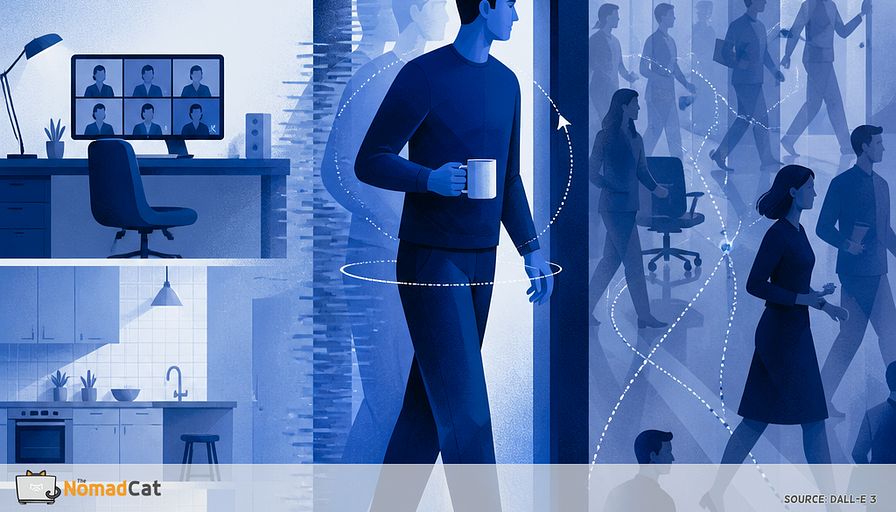
10-hour desk days. Meetings that somehow leak into the evening. A workout window that keeps getting “rescheduled” by reality. After a while, it’s easy to assume the problem is motivation. Or discipline. Or some personal flaw you should fix with more grit.
Often it’s none of that.
Remote work quietly removed a specific input your body used to get for free. Not cardio. Not strength. Something smaller and a bit weird. The constant stream of tiny near-misses and micro-adjustments that happen in shared spaces. Sidestepping someone in a corridor. Pivoting around a chair leg. Holding a door while your feet keep moving. Restarting cleanly after a stop. Your nervous system doing fast brace then release work without you logging it as “exercise”.
This article names that missing input as collision physics. It’s not medical, and it’s not dramatic. It’s just a useful way to explain why you can hit your steps, even train seriously, and still feel a bit… glitchy at home. A sharp kitchen turn. Carrying a mug while answering a message. Those little clumsy moments that show up when your brain is still in the meeting.
What you’ll get here is a practical, meeting-proof way to put that input back, without adding another system to manage.
We’ll cover
- why office life trained reactive coordination in the background, and why home life can remove it while looking “efficient”
- the difference between closed-world training and open-world walking, and why specificity can steal transfer
- the early signs this is happening, like micro-stumbles, doorframe clips, and jolty transitions that don’t show up on dashboards
- 2 simple micro-menus that reintroduce turning, thresholds, rerouting, and light carrying in 20–60 seconds
- guardrails to keep it conservative, socially invisible, and safe on chaotic calendar days
The point is relief. If your body is throwing small errors, it doesn’t mean you’re broken or lazy. It can just mean you’re missing a few inputs in the system. Small changes count. Perfection is not required.
The missing input remote work quietly removed
Collision physics is not exercise, it is coordination noise
Call it collision physics. Not medical. More like a constant stream of tiny near-misses and micro-adjustments in shared spaces. It trained fast protect then release responses across your feet, hips, trunk, and shoulders.
The office was full of tiny negotiations you never logged
These look trivial until you remember what the body has to do in about 0.5 seconds.
- Sidestep a colleague who stops mid-corridor
- Pivot around a chair leg you did not expect
- Hold a door while your feet keep moving, then restart cleanly
- Weave in a narrow passage without fully stopping
- Reroute mid-stride because someone steps back from a printer
- Do a small start-stop at the elevator, then accelerate again
- Step over a cable that appeared near a meeting room
- Turn your torso to let someone pass while keeping your base stable
The useful part is the fast on and off switch
A near-collision is a brief brace, not a full freeze. A tiny widen-and-catch step. A few degrees of hip and trunk rotation. Shoulders stay quiet. Then the key part: you let go again and return to normal within 1–2 steps.
That quick on-off control matters as much as the brace.
Home can be efficient in a way that removes the hard parts
Yes, you can work out. Strength and cardio still matter.
But home movement often becomes a clean loop. Kitchen to desk. Desk to bathroom. Same turns, same floor, no negotiation. Then remote work stacks calls, so the incentive is to make transitions even more predictable and fast.
And even if your step count looks fine, movement quality can still shift.
Why training doesn’t fully replace real life
Specificity steals transfer
You can train seriously and still feel a bit fragile when you turn too fast in the kitchen, carry something while answering a message, or walk out of a meeting with your brain still inside it.
The missing input is often not intensity. It is the constant drip of small, unpredictable corrections done while distracted and holding normal objects. A workout rewards repeating the same solution until it looks clean. Real life keeps changing the problem.
That’s the remote-work gap: fewer shared-space near-misses, fewer mid-stride reroutes, fewer “oops, let me fit through here” moments. The micro-menus below aren’t “more training”; they’re a way to put that missing unpredictability back into a remote day in tiny, safe doses.
Practice that feels a bit messy often transfers better.
Closed world training vs open world walking
A treadmill, repeated sets, or planned drills are a closed world. The surface is known. Timing is yours. Surprise is removed so you can push load safely.
“Collision physics” is an open world task. It is spontaneous brace then yield when space gets tight and attention is split.
Plain version: training is clean on purpose; hallways and kitchens are not.
Also, not everything that feels unstable is reactive coordination. The key ingredient is unpredictability, not just standing on something wobbly. And doing 2 things at once is not some edge case. It is normal life.
The small glitches you notice first
The home clumsy moments that show up out of nowhere
The weird part is usually not during exercise. It is when the brain is in thinking mode and the apartment asks for a tiny negotiation.
- Bump a hip on the counter while carrying a mug
- Clip a doorframe with a laptop corner
- Catch a falling object and feel a small “oops” in shoulder or back
- Step around a pet and feel jolty for 2 steps
- Pivot too sharp around a chair and need a micro-stumble
Not as a fear thing here. More as a reminder that a “simple” turn is not that simple.
Why it hits when your brain is still in the meeting
This is often calibration, not a verdict about your body.
You stand up after hitting send. Your brain is still half in the thread. Then something moves at the wrong angle and speed. The controller feels like it has 200 ms of lag.
Context switching is real, and it shows up in your timing: you’re physically up, but your attention is still finishing the last sentence, so the first two steps come out a little sloppy.
Treat it like a bug report, not a diagnosis
If it feels real but your trackers don’t show it, that’s not your imagination. This layer is about how movement happens, not how much movement happened.
Encouraging part: reactive control responds to practice. Still, the goal is not to turn your hallway into a lab.
Why your dashboards look fine anyway
Steps can look great with clean, straight walking and almost no turning, rerouting, or micro-avoidance. Step count alone won’t surface quality signals. I like dashboards too, but this is one of those places where the data is just not looking at the right thing.
Remote work also rewards stillness in ways nobody calls out. It is like observability where you monitor uptime, but you never collect edge-case logs, so the weird errors feel “random”.
Camera-on work selects stillness. Stable frame, quiet hands, don’t roll away to grab water. You stay frozen so you don’t look distracted, and you pay for it when you stand up and pivot too fast to beat the next calendar block.
Short breaks can be feasible and can reduce fatigue and discomfort without hurting performance (Wendsche & Lohmann-Haislah, 2017; Kim, Park & Niu, 2017). That’s part of why the menus here are 20–60 seconds: brief enough to actually happen after Leave or Send, instead of turning into a 10-minute “break” you’ll skip when things get busy.
Tiny unpredictability you can actually keep on meeting days
Safe surprises without making it weird
Safe surprises means small, self-controlled variations that force tiny course corrections. Calm pace. Low amplitude. Easy abort if anything feels sketchy. Think coordination upkeep, not conditioning.
Constraints, colleague-style:
- no sweat, no gear, no “project”
- no tracking, no apps, no new identity
- must survive calendar chaos (and yes, camera-on)
Event-cued actions often work better under chaos because they don’t rely on you remembering later. A simple “if X happens, then I do Y” plan can help.
Pick seams that already exist like Leave meeting, Send, or standing up for a bathroom break. Attach 20–60 seconds of movement texture before the next input pulls you back.
I studied fundamental physics, so I can’t help framing this as constraints and inputs, not willpower. Less guilt, more configuration.
2 micro-menus that cover most of the missing input
Menu 1, the doorway negotiation loop
On wall-to-wall call days, doorways are a good cheat code. They force turning, threshold crossing, and re-orienting, and you don’t need to “plan a walk” to get it.
Mini-protocol after clicking Leave
1) Stand up and pause 2 seconds
2) Walk through 1 doorway
3) Do 1 controlled turn and re-aim
4) Return by a slightly different path
What it trains: quick steering, turn control, transitions. Optional variation: carry a light object.
Menu 2, the light object carry with a turn
If your place is too open-plan, or too tiny to get reroutes, add a neutral object for asymmetry and segment coordination.
After a meaningful Send, do this once
- Do carry something light and boring to another room
- Do keep it close to your body, slow pace, quiet shoulders
- Do turn with your feet, not by twisting through the spine
Do switch hands sometimes
Don’t rush
Don’t do a long reach while turning
Don’t carry something unstable or heavy “just to make it count”
Why these menus are enough
They reintroduce what remote work removed: turning, re-orienting, thresholds, light load-handling. Small varied reps. Not heroic, not sweaty, just enough randomness to keep the system updated.
Make it meeting proof and safe
Camera safe execution that does not feel like a performance
Do it between calls or during audio-only moments. Keep amplitude low. No stretching theater.
Timing is the real obstacle. You remember after the next meeting starts, when it is socially harder. Pre-decided scripts help.
- “Back in 30 seconds, grabbing water.”
- “1 minute, switching rooms.”
- “Quick refill, starting at :30.”
The most common failure mode is remembering too late. Move the trigger earlier, right after Leave or Send, before opening the next tab. Once the next input hits, intention gets overwritten.
Guardrails that keep it conservative
Start easier than you think.
Pace / load
- Slow pace, low amplitude
- Light loads only, or no load
Environment
- Clear floors, good lighting, no clutter
- Shoes with traction, not socks on slick floors
- Stay within arm’s reach of stable support if balance feels off
Stop signals (get assessed)
- Repeated near-falls
- Persistent dizziness on standing
- New numbness or weakness
- Sharp escalating pain
- True giving-way
Even if movement is limited, variability can still fit.
- Supported standing turns with 1 hand on a counter
- Short countertop route with 1 controlled turn at the end
- 1 doorway pivot only, slow and clean
Tiny variability, high safety, boring enough to keep uptime.
10-hour desk days and meetings that spill into the evening can make every little clumsy moment feel like a personal failure. And yes, there can be a quiet frustration there. Maybe even a bit of guilt.
But the cleaner explanation is simpler. Remote work removed “collision physics”, those tiny reroutes, turns, stops, and near-misses that used to keep reactive coordination quietly updated.
If your steps look fine yet you still clip doorframes or feel jolty coming out of a call, it is not your character. It is missing inputs. It’s annoying because you can run a project, but you can’t turn with a mug without clipping a doorframe—and that mismatch is exactly the signal.
The fix does not need a new plan, gear, or guilt. A few 20–60 second micro-menus after Leave or Send can bring back the useful stuff. Turning, thresholds, light carries, attention split. Small variability, conservative pace, easy abort.
Perfection is not required. If the day is clean and predictable, your movement gets clean and predictable too—and that’s the bug.
You might be interested by these articles:


Micro-exits for remote days that keep your body from timing out

Clumsiness debt when the first stair feels wrong after 10 hours on screen

Audio first gives your body permission to move on remote days

Your remote day needs friction to make movement normal again

Your 18:00 stiffness is a config bug fix it with micro-variability

Maximizing Deep Learning Success Through Teamwork and Innovation

The unpaid admin work that breaks your health plan by Wednesday